

Could a label that looks unmistakably Spanish still leave you unsure what’s behind it? Spanish imagery and heritage-inspired wording can catch the eye, but they don’t tell the whole story. To choose authentic Spanish jamon serrano with confidence, look for clear details about the producer, place of production, curing, and product format.
That uncertainty is understandable. Jamón Serrano and Jamón Ibérico are both Spanish cured hams, but they come from different pig breeds and can have different characteristics. Labels may include unfamiliar terms, and a whole leg, sliced pack, or smaller portion can suit very different occasions.
This guide explains what Jamón Serrano means, how it compares with Jamón Ibérico, and which origin, label, and curing details can help you assess a ham. You’ll also find practical ways to choose a format for a shared table, a special meal, or a tasting, and to serve and store it according to its packaging. Authenticity is more than a Spanish-sounding promise: the details help tell the story.
Key Takeaways
- Look beyond Spanish imagery for clear details about a ham’s producer, production, and product identity.
- Read certification as one useful clue, not a substitute for understanding where the ham was made or how it was produced.
- Compare Jamón Serrano and Jamón Ibérico by category and label information, then assess each ham on its own merits.
- Match the format to the occasion and follow the package’s storage guidance.
- Use a few focused label checks to choose a ham for a shared spread or a simple tasting.
What Is Authentic Spanish Jamón Serrano? Understand the Ham Before You Buy
Jamón Serrano is Spanish dry-cured ham made by salting and air-curing pork. The name identifies a style, but it doesn’t tell you everything about an individual product. The producer, stated place of production, and other label details help you understand what you’re buying. For authentic Spanish jamon serrano, look for a clear product identity and production information rather than relying on Spanish colours, scenery, or wording.
The ham’s style and its stated origin are related, but they are not the same claim. A traditional Spanish presentation may suggest heritage, but packaging alone doesn’t establish where the ham was produced. Look for the producer, the stated place of production, and a specific product description. Consider these details together, without treating any one of them as proof of every aspect of quality.
What does Jamón Serrano mean on a label?
“Serrano” refers to a traditional Spanish style of dry-cured ham. It identifies a product category and curing tradition, not a single Spanish region. The Jamón Serrano overview explains the ham’s production and cultural context, including how it differs from Jamón Ibérico.
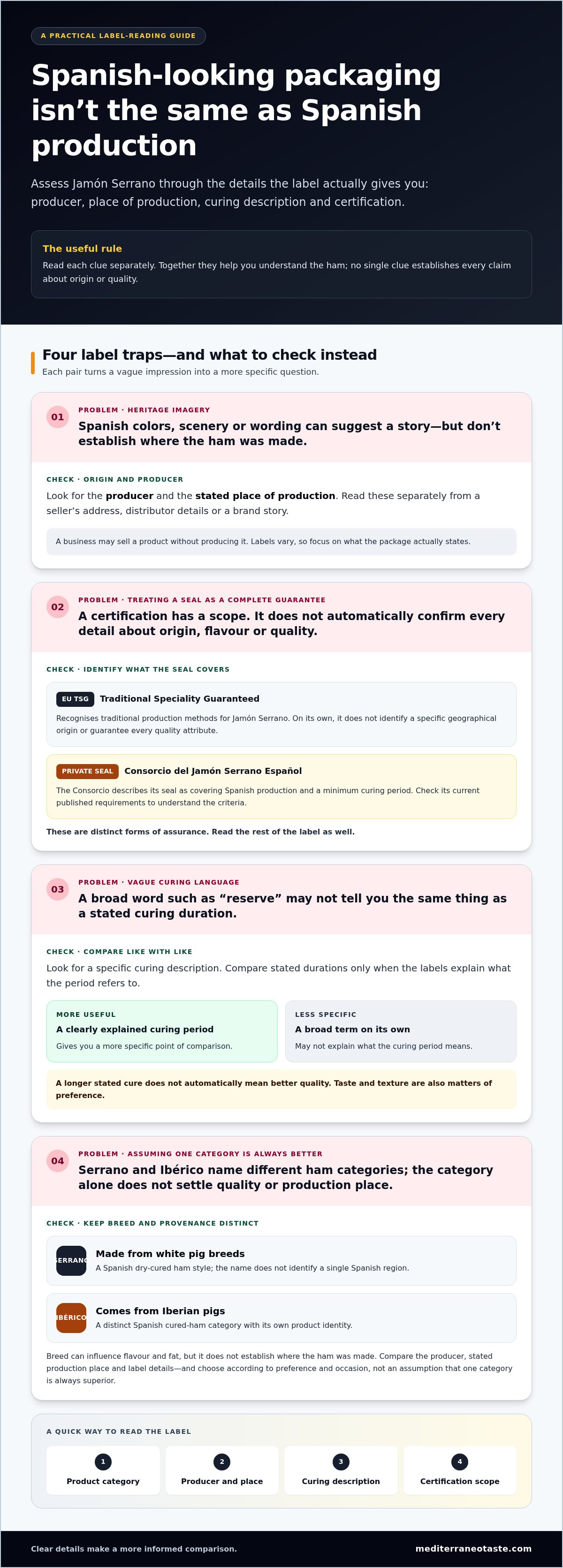
Read the product name, producer, and stated place of production separately. A label may also carry a certification, but check what it covers. The EU Traditional Speciality Guaranteed (TSG) scheme recognises traditional production methods. It does not, by itself, guarantee a specific geographical origin or every quality attribute. One seal is not a substitute for reading the rest of the label.
How is Jamón Serrano different from Jamón Ibérico?
The central distinction is the pig breed: Serrano is made from white pig breeds, while Ibérico comes from the Iberian pig. Breed can influence flavour and fat, but it doesn’t make one category universally superior. The product’s provenance and production details still matter.
- Product category: Serrano denotes dry-cured ham from white pig breeds; Ibérico denotes ham from Iberian pigs.
- Label clues: Look for the category name, producer, place of production, and any clearly described certification. Breed alone doesn’t establish where the ham was made.
- Tasting context: Both can be enjoyed on their own or as part of a Spanish-style spread. Choose according to your preferences and occasion, not on the assumption that one category always signals better quality.
Keep the categories distinct, then assess the ham in front of you. A clear label gives you a more useful starting point for choosing.
How Provenance, Curing, and Certification Help You Judge Jamón Serrano
Assess three things separately: where the ham was produced, what the label says about its production, and what any certification covers. These clues work together, but none replaces the others. A Spanish brand story, for example, is not the same as a stated production location. For authentic Spanish jamon serrano, clear, specific information makes it easier to understand the product and compare it with another ham.
What should you look for in origin and producer information?
Read the label closely. Identify the producer and the stated place of production, and distinguish these from the seller’s address, distributor details, or a brand story about Spanish heritage. A business may sell a product without producing it, so these details answer different questions.
Labels vary, and optional information may not appear on every product. Focus on what the label actually states rather than assuming it must contain particular details. When two products provide similarly clear producer and production information, you have a more useful basis for comparison than Spanish imagery alone.
What does a certification or curing description tell you?
The EU Traditional Speciality Guaranteed (TSG) scheme recognises traditional production methods for Jamón Serrano. It does not, on its own, identify a specific geographical origin or guarantee every aspect of quality. A certification can show that a product meets the scheme’s defined traditional criteria, but it can’t establish every claim about origin, flavour, or overall quality.
A separate, private quality seal may set its own criteria. The Consorcio del Jamón Serrano Español describes its seal as covering Spanish production and a minimum curing period. Check the seal’s current published requirements to understand what it represents. A private seal and the EU TSG scheme are distinct forms of assurance.
Curing descriptions are most useful when they’re specific and comparable. If one label gives a duration and another uses a broad term such as “reserve,” the phrases may not describe the same thing. Compare stated durations only when the labels explain what the period refers to. A longer stated cure does not automatically mean better quality; taste and texture are also matters of preference.
- Provenance: Find the stated place of production and the producer.
- Production: Read the curing description and note how specifically it is explained.
- Certification: Identify the scheme or seal, then check its scope and criteria.
These checks turn a heritage-led impression into a more informed choice. To explore Spanish and Mediterranean flavours to enjoy alongside your meal, browse Mediterranean delicacies.
Jamón Serrano vs. Jamón Ibérico: Compare the Details That Matter
Both are Spanish dry-cured hams, but their category names point to an important difference: the pig breed. Serrano is made from white pig breeds; Ibérico comes from Iberian pigs. That distinction helps identify the product, but it doesn’t tell you everything about production, provenance, or quality. Use the full label to make the comparison.
| What to compare | Jamón Serrano | Jamón Ibérico |
|---|---|---|
| Category | Dry-cured ham from white pig breeds. | Dry-cured ham from Iberian pigs. |
| Label clues | Look for the Serrano category name, producer, and any clearly described curing or certification details. | Look for the Ibérico category name and any specific breed or feeding claims stated on the label. |
| Provenance | Check the stated producer and place of production separately from the category name. | Apply the same check. The breed category alone doesn’t establish where the ham was produced. |
| Buying consideration | Compare the product description and format with your intended meal or tasting. | Use the same criteria; don’t treat the category name as a complete quality assessment. |
Which label clues distinguish Serrano and Ibérico ham?
Start with the category wording, then read any breed information in context. A breed claim helps identify the type of ham, while producer and production-place details help you assess provenance. No single label detail proves everything: a breed term or Spanish brand story doesn’t establish origin, curing approach, or individual quality. For authentic Spanish jamon serrano, weigh the clues together rather than relying on one word or seal.
Which style suits your meal or occasion?
Let the occasion guide your choice. For tapas, choose a format that’s easy to serve alongside other small dishes. For a shared board, consider how the ham will fit among the other flavours and how many people will be tasting it. For a simple tasting, keep the selection modest and focus on the ham itself. Neither category is a universal winner; the right choice depends on your preferences, the product information, and the occasion.
For more ideas for a relaxed spread, explore Spanish appetizers for tapas at home. Then compare the category, read beyond the label headline, and match the ham to your plans.
How to Choose, Store, and Serve Jamón Serrano with Confidence
A little planning makes it easier to choose a ham that fits your table and enjoy it as intended. Use this checklist before buying:
- Decide how you’ll serve it. A quiet tasting, tapas spread, and larger gathering call for different amounts of preparation and presentation.
- Review the label. Check the product description, producer, stated place of production, and any curing or certification details.
- Choose a format. Consider whether ready-sliced portions or a whole piece better suits your time, serving style, and portioning preferences.
- Read the storage instructions. Follow the package guidance before opening and for storing any ham that remains.
Which format works for your table?
Pre-sliced ham can simplify serving: open the pack and arrange the slices for tapas or a tasting. A whole piece requires more preparation and portioning, but lets you shape the presentation as you serve. Either can work on a shared board. Consider how comfortable you are preparing portions, how many people will taste the ham, and how much time you want to spend setting the table.
For a tasting, keep the arrangement simple so each slice is easy to appreciate. For a board, place the ham where guests can reach it and leave room for the other dishes. Choose the format that makes serving straightforward for your occasion.
How should you store and serve cured ham?
Start with the package. Storage directions can vary by product and format, so follow the instructions for the ham you’ve chosen instead of relying on a universal shelf-life or temperature rule. After opening, reseal or wrap it as directed and follow any guidance for using the remaining portion.
When you’re ready to serve, follow any preparation instructions on the label. Arrange the ham on a clean plate or board, and add other Spanish delicacies if you’d like a more varied spread. Thoughtful presentation lets the ham take its place among the other flavours without making the preparation complicated.
Once your serving plan is clear, explore Spanish and Mediterranean delicacies to bring more Spanish food products to your table.
Bring Authentic Spanish Jamón Serrano into a Thoughtful Mediterranean Spread
Choosing with confidence comes down to a few clear checks: understand the product name, read the provenance and production details, know what any certification covers, and choose a format that fits your plans. With those details in view, authentic Spanish jamon serrano can be part of a considered meal, not just admired for its label.
What can you serve alongside Jamón Serrano?
A Spanish-style spread can be simple. Offer bread, olives, and a few other accompaniments, then give the ham room on the plate. Complementary flavours add variety without crowding the tasting. You can also serve it on its own if you’d rather focus on its texture and character.
For a relaxed tapas table, arrange a small selection so guests can build bites to suit their tastes. If you’re setting out a Mediterranean pantry, choose a few elements that bring contrast and keep the spread balanced. Our guide to Mediterranean pantry essentials offers further inspiration for assembling a table with care.
Where can your Spanish food discovery continue?
The same thoughtful approach applies beyond ham. Look for clear product descriptions and useful provenance details as you explore Spanish ingredients. The guide how to spot authentic Spanish ingredients offers another way to read food labels and heritage claims with care.
Mediterraneo Taste Spain brings together Mediterranean delicacies and traditional Spanish food products for enjoying these flavours at home. Browse the Spanish and Mediterranean delicacies and find inspiration for your next dish or sharing table.
Choose with Confidence, Then Savour the Discovery
Authentic Spanish jamon serrano is easier to assess when you look beyond the name. Check the producer and stated place of production, read what any certification covers, and treat curing details as useful context rather than a shortcut for judging quality.
Keep the distinction between Serrano and Ibérico clear: breed defines the category, but it doesn’t tell the whole story of a ham’s provenance or production. Choose a format and serving approach that suit your table, and follow the product’s storage guidance.
Let those practical checks lead to the pleasure of sharing Spanish food. Mediterraneo Taste Spain specialises in Mediterranean delicacies and traditional Spanish food products for enjoying at home. Explore Spanish and Mediterranean delicacies and find inspiration for your next thoughtful spread.
Choose thoughtfully, serve simply, and enjoy discovering the flavours and traditions behind each bite.
Frequently Asked Questions
What makes Jamón Serrano authentic?
Authentic Jamón Serrano is Spanish dry-cured ham identified as Serrano, with product and production details that help you understand what you’re buying. Look for the producer and stated place of production, and read any curing description or certification carefully. A Spanish-sounding name, flag, or scenic packaging alone doesn’t prove where the ham was made. Consider these details together rather than relying on one label cue.
Is Jamón Serrano the same as Jamón Ibérico?
No. They are distinct categories of Spanish dry-cured ham, chiefly distinguished by pig breed: Serrano is made from white pig breeds, while Ibérico comes from Iberian pigs. The category name doesn’t tell you everything about a ham’s production, provenance, or quality. Read the full label for the producer and place of production, then compare the product details with your preferences and the occasion.
Does Jamón Serrano have a protected designation?
Jamón Serrano is recognised under the European Union’s Traditional Speciality Guaranteed (TSG) scheme, which concerns traditional production methods. TSG is not the same as a geographical designation: it doesn’t establish that a ham comes from one particular Spanish region. Treat the seal as information about defined traditional criteria, not as proof of every quality claim or a substitute for checking the product’s origin and label.
How can you tell where Jamón Serrano was made?
Check the label for the producer and the stated place of production. Distinguish these from a seller’s address, distributor information, or a brand story about Spanish heritage, since they describe different parts of the product’s journey. Clear production information can help you compare hams, but labels vary. Don’t infer a precise origin from Spanish imagery or the Serrano category name alone.
How should Jamón Serrano be stored after opening?
Follow the storage directions on the product’s packaging, including guidance for after opening. Instructions may differ by product and format, so avoid applying a universal shelf-life or temperature rule. Reseal or wrap the remaining ham as directed and follow any stated advice on how long to keep it. If the label gives separate instructions for an opened pack, use those rather than the unopened-package guidance.
What is the best way to serve Jamón Serrano?
Keep it simple: follow the package’s serving directions, arrange the ham on a clean plate or board, and let it take centre stage. For a tasting, keep accompaniments minimal so you can focus on the ham. For a meal, serve it with a few complementary foods if you like. Choose a format that suits your preparation time and serving style.
Can Jamón Serrano be part of a tapas board?
Yes. Jamón Serrano can be a centrepiece on a tapas board, served with a small selection of complementary Spanish-style accompaniments such as bread and olives. Keep the arrangement uncluttered so the ham remains easy to enjoy. For a shared table, consider how guests will reach and serve each item. There’s no fixed pairing required; shape the board around your tastes and occasion.