

The most attractive pack of bomba rice for sale isn’t necessarily the best match for your paella. A confident choice starts with the details behind the label: the rice variety, stated origin and pack information, plus whether it suits the style of rice dish you plan to cook. The names and descriptions on product pages can leave important questions unanswered, so it pays to compare the details rather than the packaging alone.
This guide explains what sets bomba apart, which clues to look for on a product listing or packet, and how to compare buying options for your kitchen in Spain. You’ll also learn how to match your choice to a traditional Valencian paella or another Spanish rice dish, and how to explore authentic Spanish paella ingredients from Mediterraneo Taste Spain. By the end, you’ll have a practical way to assess a listing and plan what you need for your meal.
Key Takeaways
- Learn what makes bomba rice suited to paella and which product details help you assess a listing.
- Understand why liquid, pan shape, heat and recipe all influence the finished rice.
- Compare bomba with the rice named in your recipe using product details, not assumptions about similar varieties.
- Use a simple checklist to review pack information, Australian-dollar pricing and delivery terms when comparing bomba rice for sale.
- Explore Spanish paella ingredients from Mediterraneo Taste and choose what suits the meal you plan to prepare.
Buying Bomba Rice for Paella: What Should You Look For?
Bomba is a short-grain rice variety used for paella. A product listing should make clear whether the rice is bomba and where that particular product was grown. The variety name alone doesn’t confirm a packet’s origin, producer or suitability for every paella recipe.
When comparing bomba rice for sale, read the listing for specific product details instead of relying on a polished image or a broad claim of authenticity. A useful description identifies the variety, producer or packer, stated origin and net weight. These details help you understand what is being offered and compare like with like. If a detail is absent, it is simply information you can’t use in your comparison.
Start with the recipe you intend to cook. Traditional Valencian paella, seafood paella and other Spanish rice dishes aren’t interchangeable just because they’re cooked in a paella pan. Follow the recipe’s named rice variety where possible, then check whether the product listing matches it. This keeps your decision grounded in both the dish and the product itself.
Which details on a bomba rice listing matter?
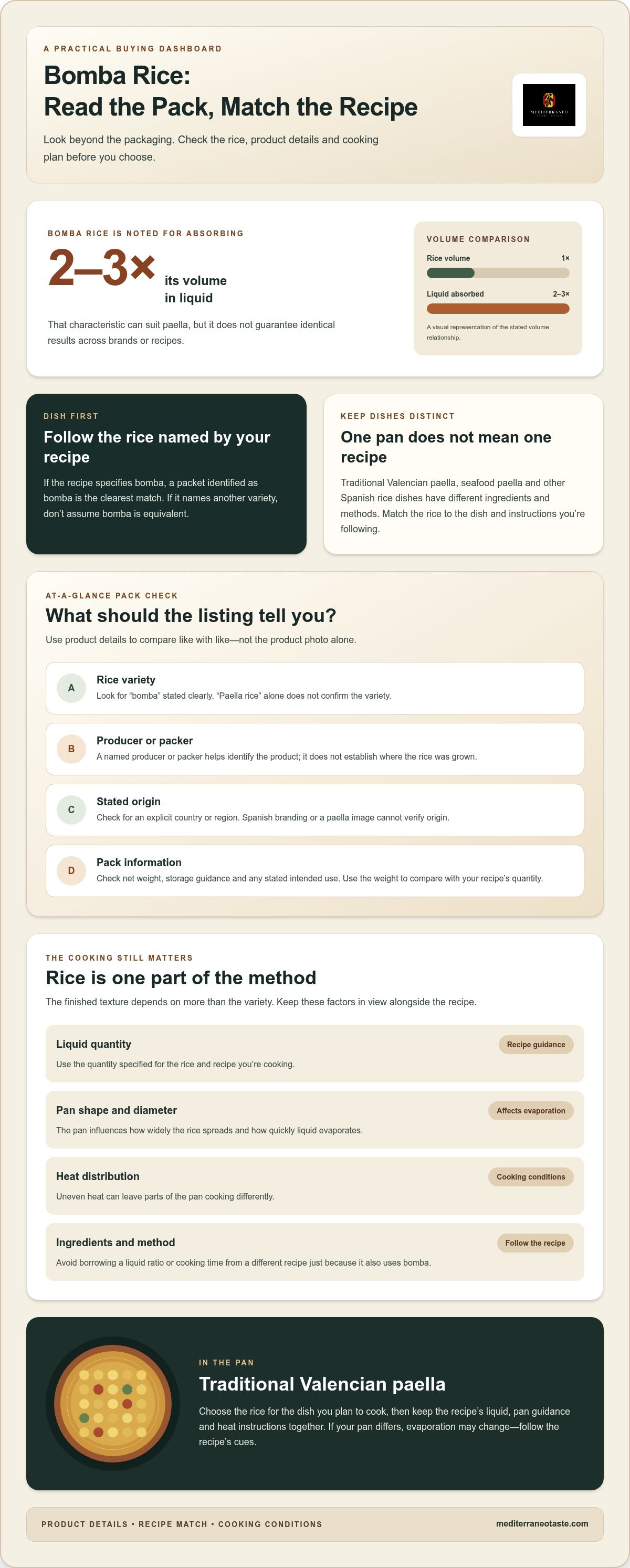
Look for “bomba” stated clearly as the rice variety, rather than relying on “paella rice” alone. Then check for a named producer, an explicit country or region of origin, and pack information such as net weight. Those details help you identify the product and compare its pack size with the amount your recipe calls for.
Check the packet or listing for practical information too, including storage guidance and any stated intended use. Treat each claim separately: a producer name doesn’t establish origin, and a description that mentions paella doesn’t prove the rice is bomba. Paella imagery may suggest how the product is used, but it can’t verify what is inside the pack.
What does ‘Valencian rice’ tell a buyer?
“Valencian rice” may point to a regional connection, but its meaning depends on the wording and evidence shown for that specific product. Look for a clear origin statement naming a place or region, and distinguish it from general phrases such as “Spanish-style paella rice”. A style description suggests how the rice is intended to be used, not necessarily where it was grown.
Don’t assume that “Valencian” means a protected designation, certification or guarantee of a particular producer. A listing needs to state such credentials explicitly before you can treat them as verified. If origin matters to your choice, use the stated origin rather than inferring it from a dish photograph, Spanish branding or regional wording.
Finally, check that the pack size suits the quantity in your recipe. A clear net weight helps you plan what to buy without guessing. Mediterraneo Taste offers Spanish ingredients and paella products for Australian cooks, including paella ingredient kits. Keep the recipe and the details provided for each product at the centre of your choice.
How Bomba Rice Behaves in Paella, and What That Means for Your Choice
Rice is part of the cooking method, not a shortcut around it. Bomba’s ability to take up cooking liquid makes it a popular choice for paella, but the finished texture still depends on how the dish is cooked. The variety alone can’t account for the pan, heat, ingredients or instructions used in a particular recipe.
Bomba rice is noted for absorbing two to three times its volume in liquid without bursting. This characteristic supports its use in paella, but it doesn’t guarantee identical results across brands or recipes.
Why rice characteristics matter in paella
As rice cooks, it takes up liquid and expands. In paella, the grains cook in a broad layer with the cooking liquid, rather than being drained after boiling. Bomba’s absorption characteristics can suit this approach, but a general description of the variety doesn’t prove that every packet behaves identically. Product quality, recipe and cooking conditions all play a part.
Liquid quantity is one variable. The pan’s diameter and shape also affect how widely the rice is spread and how quickly liquid evaporates. Heat distribution matters too: uneven heat can leave parts of the pan cooking differently. Changing one variable without considering the others can alter the result, even when you’ve chosen the rice named in the recipe.
Match the rice to the recipe, not just the dish name
Before buying, check the recipe’s exact rice recommendation. If it specifies bomba, a packet identified as bomba is the clearest match. If it names another variety, don’t assume bomba will behave the same way or that a product labelled only “paella rice” is an equivalent substitute. Follow the recipe’s method for the variety it names.
The dish matters as well. Traditional Valencian paella has its own characteristic ingredients and method; seafood paella is a different preparation, and other Spanish rice dishes have their own approaches. They may share a pan or some cooking techniques, but that doesn’t make them the same recipe. Choose rice according to the dish and instructions you’re following.
Once you’ve settled on the rice, keep the recipe’s liquid quantity, pan guidance and heat instructions together. Avoid borrowing a ratio or cooking time from a different recipe simply because it also uses bomba. If your pan differs from the one described, evaporation may change. Watch the cooking process and follow the recipe’s cues rather than expecting the rice variety to compensate for a different pan or method.
For a paella built around Spanish ingredients, explore Spanish paella ingredients alongside your chosen recipe. Pairing the right rice with a suitable cooking plan is a more reliable starting point than relying on the variety name alone.
Bomba Rice vs Other Paella Rice: Compare the Buying Details
Rice names can make a product search feel like a simple ranking. A more useful comparison starts with your recipe, then checks what each listing actually says. Bomba is a specific rice variety used for paella, but the name alone doesn’t tell you the origin, producer or pack size of a particular product. Those details need to come from its listing or packet.
Use the table as a comparison framework, not a verdict on which rice is “best”. For bomba and Calasparra, origin and pack information depend on the individual product. A recipe naming either variety can guide your choice, but it doesn’t verify a product’s provenance.
| Rice named by a recipe | What the name tells you | What to verify on the listing | Recipe fit |
|---|---|---|---|
| Bomba | A specific rice variety used for paella | Producer, stated origin and pack size | A direct match when the recipe specifies bomba |
| Calasparra | The named variety or rice type called for by the recipe | How the seller identifies the rice, plus origin, producer and pack size | Follow the recipe that names it; don’t assume it is interchangeable with bomba |
| Another named rice | The variety or type the recipe asks you to use | Whether the listing explicitly names that rice, and its stated product details | Use the recipe’s method and guidance for that choice |
Which comparison points help shoppers decide?
Compare each product using the same checklist: named variety, producer, stated origin, net weight and intended use. If a listing doesn’t give one of those details, record it as “not stated”. That isn’t proof of a defect; it means you can’t use that detail to distinguish the product. Don’t infer origin from branding or paella imagery, and compare prices only when you have current, like-for-like Australian retail information.
When should you choose bomba for paella?
Choose bomba when your recipe specifically calls for it and the product listing identifies the rice as bomba. If the recipe names another variety, follow its stated method rather than assuming a swap will cook the same way. Bomba can suit paella, but it isn’t the only appropriate choice for every recipe and doesn’t guarantee a particular result.
Keep the comparison tied to the dish you plan to prepare. Traditional Valencian paella, seafood paella and other Spanish rice dishes are distinct preparations, and their recipes may specify different ingredients or methods. The dish name alone doesn’t settle which rice to buy. Consider the recipe’s rice instruction and cooking guidance together.
This approach makes bomba rice for sale listings easier to assess without treating every packet as identical. Choose the product whose stated variety fits your recipe, then use its producer, origin and pack details to make an informed comparison. Where information is unstated, avoid filling the gap with assumptions.
How to Buy Bomba Rice in Australia: A Practical Checklist
A careful product-page check helps you buy rice that fits your recipe, rather than relying on a pack image or a broad paella label. Keep the recipe and its measured rice quantity beside you as you compare bomba rice for sale. Then review the listing details, price and delivery terms shown for Australian customers. If a detail isn’t stated, treat it as unknown instead of filling the gap with an assumption.
A five-step product-page check
Work through these checks in order. Start with the dish you’ll cook, then compare the recipe’s rice requirement with the product information. This helps distinguish a clear match from a listing that leaves key details unanswered, and lets you plan a suitable quantity without guessing at servings per pack.
- Review the recipe. Note the rice variety it specifies and the intended number of diners. Keep the recipe’s measured quantity to hand; the number of people alone doesn’t tell you how much rice to buy.
- Confirm the variety and pack details. Check that the listing explicitly identifies the rice as bomba and gives clear pack information, including net weight. Don’t infer a variety from paella imagery or general wording.
- Read the origin and producer statements. Look for details the product page states directly. If it doesn’t name a producer or origin, record that as “not stated”. Packaging design, brand style and a Spanish-sounding name aren’t proof.
- Review the current price and delivery terms. Check the Australian-dollar price and delivery details displayed on the retailer’s page before deciding. These can vary between retailers and over time, so use the current listing rather than an old search result or a general estimate.
- Calculate the quantity you need. Use the recipe’s measured rice amount and compare it with the net weight shown for each pack. Work out how many packs cover that quantity, following the retailer’s pack options. Don’t infer servings from a pack’s weight or a supplier’s bulk quantity; if the listing gives no recipe guidance, it doesn’t establish servings per pack.
Keep a simple note of each listing’s variety, origin, producer, pack weight, price and delivery terms. This makes comparisons clearer, especially when one page includes more detail than another. “Not stated” is a useful note, not a verdict on product quality.
For the rest of your menu, Mediterraneo Taste offers Spanish paella ingredients for Australian customers, including ingredient kits and Spanish food products. Explore the range alongside your recipe, then use the same measured-quantity approach to plan what you need for the meal.
Explore Spanish Paella Ingredients for Your Next Meal
A thoughtful rice choice begins with the recipe, not just the word “paella” on a packet. Follow the variety and method your recipe specifies, inspect the product details for stated evidence, and use the recipe’s measured quantity to work out how much rice to buy. These steps help you choose ingredients with purpose, without assuming every Spanish rice dish or product listing is the same.
Choose ingredients that fit the paella you plan to cook
Build your shopping list around the particular dish. Traditional Valencian paella, seafood paella and other Spanish rice dishes have distinct recipes, so consider the rice alongside the other ingredients and instructions. If the recipe calls for bomba, look for a listing that names that variety. If it specifies another rice, follow its guidance rather than treating bomba as a universal substitute.
Ingredient kits can make it easier to gather components for a Spanish meal. Antonio Sotos, Mediterraneo Taste’s ingredient partner, is a family business from La Mancha established in 1912. Its paella ingredient kits combine seasoning, rice, olive oil and a pan. Replacement packs contain ingredients only. Check the details of the particular product, and don’t assume the rice in a kit is bomba unless the product information says so.
Keep food and cooking equipment distinct as you plan. An ingredient kit provides food components, while a Garcima equipment set combines cooking hardware such as a pan, burner and accessories. They serve different roles, so consider what your recipe needs and what your kitchen already has. Rice selection is one part of the meal; the appropriate pan and cooking equipment support the method you’ll use.
Continue exploring authentic Spanish cooking
Mediterraneo Taste is an Australian retailer of Spanish food products and paella-related items. Its range includes Spanish ingredients and paella equipment, making it easier to bring the components of a Spanish-inspired meal together. Keep the recipe close as you browse so each ingredient you choose has a clear place in the meal.
If you’re comparing bomba rice for sale, focus on the stated variety, origin, producer and pack information, then match the quantity to your recipe. Don’t infer a rice type from a kit name, attractive packaging or a general paella description. A careful choice is more useful than a broad promise, and it leaves you ready to cook with confidence.
Explore Spanish paella ingredients and food products from Mediterraneo Taste as you plan your next meal. Choose ingredients that suit your recipe, gather the quantities you need, and enjoy preparing a Spanish-inspired table.
Set the Table for Your Next Paella
Let your next paella plan begin with the recipe you’re excited to cook. Choose ingredients that suit its method, then give each one room to contribute, from the rice that forms the base to the Spanish flavours that bring the dish together. Comparing bomba rice for sale is one part of a bigger pleasure: preparing a meal with intention.
For Australian cooks seeking authentic Spanish food products, Mediterraneo Taste brings Spanish ingredients together in one place. Its ingredient partner, Antonio Sotos, is a La Mancha family business established in 1912. Explore the range and choose ingredients that fit the meal you have in mind.
Explore Spanish paella ingredients and find inspiration for your next Spanish-inspired meal. Browse Mediterraneo Taste’s ingredients and paella products to plan your next meal.
Frequently Asked Questions
Where can I buy bomba rice in Australia?
Look for Australian retailer listings that name bomba explicitly, then read the product details rather than relying on “paella rice” wording alone. To assess bomba rice for sale, compare the stated variety, producer, origin and pack size, and check the current Australian-dollar price and delivery terms on the retailer’s page. Mediterraneo Taste is an Australian retailer of Spanish food products and paella ingredients. Its paella ingredient kits include rice, but the product information should be read for the specific contents and rice variety.
Is bomba rice the best rice for paella?
There isn’t one best rice for every paella recipe. Bomba is used in paella recipes, but the right choice depends on the recipe’s intended result and cooking method. Follow the variety named in the instructions before substituting. Also identify the dish correctly: traditional Valencian paella, seafood paella and other Spanish rice dishes have distinct recipes, so a rice recommended for one isn’t automatically the right choice for another.
What is the difference between bomba rice and regular rice?
Bomba is a named rice variety commonly selected for paella, while “regular rice” can refer to many different varieties and product types. The broad label alone doesn’t tell you how a particular rice will cook or where it comes from. Check the pack or listing for the stated variety, then compare it with the recipe’s instructions. Treat product claims as specific to that product, not every rice sold under a similar label.
Can I substitute bomba rice in a paella recipe?
You may be able to substitute another rice, but the right choice depends on the recipe and the alternative variety. First look for substitution guidance in the recipe itself. A different rice may need a different approach, so don’t assume its liquid quantity or cooking instructions transfer unchanged. If the recipe gives no substitution advice, choosing the variety it names is the clearest way to stay aligned with its method.
How much bomba rice should I buy for paella?
Use the recipe’s measured rice quantity to decide what to buy, with the planned number of diners as context. Check whether the recipe gives a total amount for the meal rather than estimating from the number of people alone. Compare that quantity with the net weight on each pack to work out what you need. Pack size or supplier bulk quantities don’t establish serving capacity.
How should I store bomba rice after opening?
Follow the storage directions printed on the specific packet, as packaging and product guidance can differ. As a general dry-rice pantry practice, keep the rice sealed in a clean, dry place away from heat and moisture. If the original pack isn’t resealable, use a suitable sealed container. Don’t rely on a guessed shelf life; refer to any date and storage instructions supplied with the product.
Is bomba rice from Valencia?
Not necessarily. Check the origin stated on the particular product’s label or listing rather than inferring it from the variety name. A named place of origin is not, by itself, proof of a certification or protected designation. Look for explicit evidence before treating a credential as verified.