

Authenticity is not a marketing buzzword; it is a legally protected standard of Spanish heritage and craftsmanship. You've likely felt that sting of disappointment when a promised gourmet experience falls flat because the saffron lacked its signature earthy depth or the rice failed to absorb the rich flavors of a perfect paella. It's frustrating to pay premium prices for what turns out to be a low-grade imitation. When you seek to buy authentic spanish ingredients, you're looking for more than just food; you're inviting a centuries-old tradition into your home.
We understand that the maze of European certifications and the latest 2026 food labeling regulations can feel more like a barrier than a guide. This article promises to turn you into a master curator of your own pantry. You'll learn to decode DOP and IGP seals with ease and avoid the common pitfalls that ruin complex dishes. We will explore the essential markers of quality, from the specific texture of premium Ibérico ham to the harvest secrets of genuine Spanish saffron. Prepare to transform your culinary journey into a sophisticated celebration of true Mediterranean excellence.
Key Takeaways
- Master the art of the label; learn to distinguish between DOP and IGP certifications to ensure every artisanal discovery is genuine.
- Navigate the market with confidence when you buy authentic spanish ingredients by identifying the specific visual cues of heritage products.
- Elevate your culinary creations by choosing high-absorption Bomba rice over generic grains, ensuring a perfect sensory experience every time.
- Protect your investment by performing simple aromatic "smell tests" to separate real Spanish saffron from synthetic food colorings.
- Transform your kitchen into a Mediterranean sanctuary by selecting ingredients that carry the official seal of Spanish craftsmanship.
The Quest for Authenticity: Why Genuine Spanish Ingredients Matter
Imagine the scent of sun-warmed rosemary and the sharp, smoky aroma of pimentón drifting through a Mediterranean kitchen. Flavor is a legacy. It isn't just about following a recipe; it's about the soul of the ingredients. When you choose to buy authentic spanish ingredients, you're investing in a history of excellence that mass-produced imitations cannot replicate. "Spanish-style" often signals a generic approximation made anywhere in the world. In contrast, "Product of Spain" guarantees that the unique terroir-the specific combination of soil, climate, and tradition-is present in every bite.
Authentic ingredients transform a simple dinner into a sensory event. The difference lies in the artisanal methods. While industrial factories prioritize volume, Spanish artisans prioritize the slow, deliberate process of creation. This dedication ensures that your olive oil carries the peppery finish of Andalusian olives and your saffron holds the intense, floral notes of the La Mancha plains. These products are often protected by the Denominación de Origen (DOP) system, which preserves the integrity of these regional treasures through strict legal standards.
The Cultural Heritage of Spanish Craftsmanship
Small family producers are the guardians of Spain's culinary secrets. They pass down generational knowledge that no machine can mimic. From the hand-harvested sea salt of the Atlantic coast to the traditional forging of a polished steel paella pan, every tool and technique leaves a mark on the final flavor. Preserving this craftsmanship is essential for anyone who wants to capture the true spirit of Spanish home cooking. It's an invitation to experience history through your palate. Trust the hands that have tilled the land for centuries.
The Hidden Cost of Low-Quality Substitutes
Cheap alternatives often come with a high price for your final dish. Texture is everything. Generic short-grain rice lacks the structural integrity of true Bomba rice; it turns into a mushy disappointment rather than absorbing the rich broth of a paella. Chemically-treated saffron provides a harsh, artificial yellow without the complex aroma of the real "Red Gold." Choosing to buy authentic spanish ingredients is a more sustainable choice for your kitchen. It supports heritage farming and ensures your Mediterranean experience is honest, vibrant, and deeply satisfying. Don't settle for a pale imitation of greatness.
Decoding the Labels: DOP and IGP Certifications Explained
Unlocking the secrets of the Spanish pantry requires a keen eye for detail and a respect for history. When you set out to buy authentic spanish ingredients, the packaging serves as your first guide. The European Union uses EU geographical indication schemes to protect both producers and consumers from the confusion of the global market. These labels aren't just marketing; they're legal guarantees that the product in your hand possesses the specific qualities and reputation of its home region.
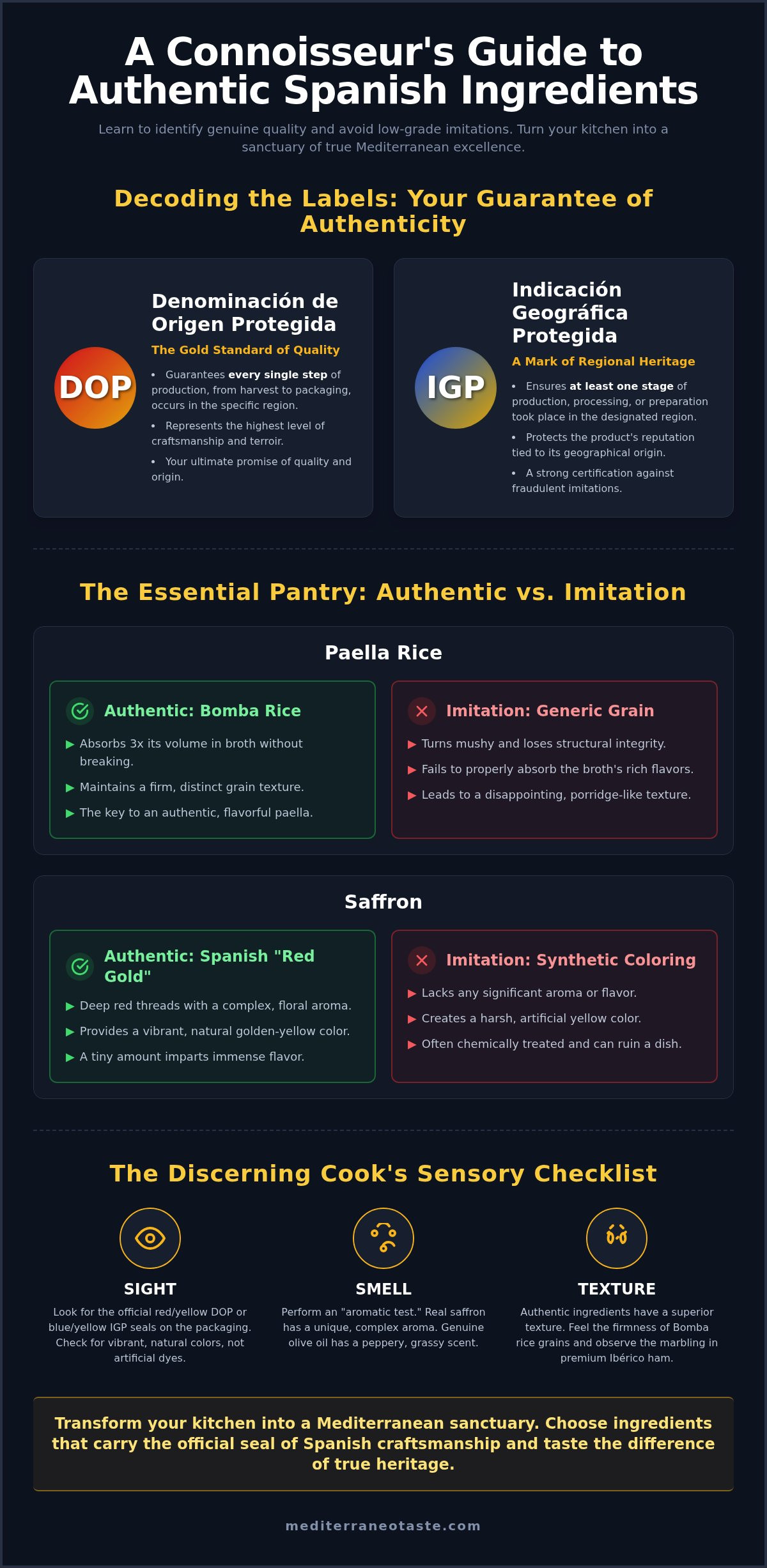
The red and yellow seal of the DOP (Denominación de Origen Protegida) is the ultimate promise of quality. It confirms that every single step of production, from the raw harvest to the final packaging, occurred within a strictly defined geographical area. If you're looking for the highest level of craftsmanship, this is your gold standard. The IGP (Indicación Geográfica Protegida), marked by a blue and yellow seal, indicates that at least one of the stages of production, processing, or preparation took place in the designated region. Both certifications ensure you aren't wasting money on low-grade imitations.
Why Protected Designations Exist
These designations exist to defend the honor of the land and the families who work it. They provide a rigorous framework for quality control, ensuring that every jar of peppers or bottle of oil meets specific sensory profiles. By enforcing these standards, the EU prevents the fraud of "imitation" gourmet goods that often flood the market. As of August 2026, new anti-greenwashing rules mean these certifications are more vital than ever for verifying the artisanal claims on a label. They offer a transparent path for anyone who values the Mediterranean diet.
Common Spanish Certifications to Look For
Keep a sharp eye out for these specific icons of excellence during your next shopping trip:
- Pimentón de la Vera: This smoked paprika from Extremadura is dried over oak fires, providing a depth of flavor that industrial alternatives can't match.
- Azafrán de la Mancha: With retail prices for Spanish Coupé or Mancha saffron reaching €5 to €9 per gram, this seal protects you from adulterated threads.
- Arroz de Valencia: This is the essential certification for your paella, ensuring the grain has the precise starch content needed for perfect absorption.
You can explore a curated selection of Mediterranean delicacies that carry these prestigious seals, ensuring your kitchen is stocked with only the finest heritage products. Finding these labels is the simplest way to buy authentic spanish ingredients without the guesswork. It turns every purchase into a confident investment in flavor and tradition.
The Essential Spanish Pantry: A Comparative Analysis
Building a collection of Mediterranean treasures requires more than just checking seals; it demands an understanding of how these elements perform in the heat of the kitchen. When you decide to buy authentic spanish ingredients, you're selecting the performers for a culinary stage. The difference between a masterpiece and a mediocre meal often rests in the specific grains and threads you choose. Authentic products behave differently because they are grown and processed to meet the rigorous standards of EU quality schemes.
The Holy Trinity of Paella Ingredients
Bomba rice is non-negotiable for a serious cook. While generic short-grain rice collapses into a mushy texture, Bomba is a marvel of absorption. It can soak up three times its volume in broth without breaking, remaining distinct and firm. This structural integrity is essential for creating the "socarrat," which is that prized, caramelized crust at the base of your paella pan. It's a texture that generic rice simply cannot achieve.
Real saffron, or "Red Gold," is equally transformative. Identifying authentic threads is simple: look for deep crimson color and trumpet-shaped tips. Avoid powders or "yellow coloring" which offer no flavor. Authentic Spanish saffron, currently retailing between €5 and €9 per gram, provides a complex, floral aroma that anchors the dish. Smoked pimentón completes the trio. Unlike standard sweet paprika, the authentic variety is dried over oak smoke, offering a foundational depth that industrial alternatives simply lack.
Beyond the Pantry: Authentic Spanish Cookware
The right equipment is the silent partner of quality ingredients. A traditional paella pan is wide and shallow by design. This shape maximizes the surface area, ensuring that liquid evaporates at the correct rate while the rice cooks evenly. Polished steel is the gold standard for those seeking a traditional experience; it responds quickly to temperature changes and develops a natural patina over time. Enamelled options offer a modern alternative with easier cleanup, but they lack the specific heat-conducting soul of raw steel.
Finally, consider your olive oil. Artisanal pressings of Extra Virgin Olive Oil (EVOO) are the lifeblood of the Mediterranean. Refined oils are stripped of their character, but artisanal pressings retain a vibrant, peppery finish. As of August 2026, the origin price for Spanish EVOO is approximately €3.65/kg. When you buy authentic spanish ingredients, you're not just stocking a pantry; you're curating an experience that honors the landscape and the artisan. Choosing the right vessel is just as critical as the contents themselves.
The Discerning Cook’s Sensory Checklist for Quality
Your senses are the ultimate lie detectors. When you set out to buy authentic spanish ingredients, you're looking for a physical connection to the land that transcends a simple label. Start with your eyes. Authentic pimentón should be a deep, vibrant red, never dull or brownish. Rice grains should be uniform and pearly, lacking the dusty residue found in mass-market bags. These visual cues are the first indicators that the product has been handled with the respect it deserves.
Aromatics provide the next layer of truth. Premium spices don't just smell "good"; they smell specific. True Spanish smoked paprika should hit you with a clean, wood-smoke scent immediately upon opening the tin. If it smells dusty or faint, it's likely past its prime or poorly processed. Artisanal producers prioritize the volatile oils that carry these scents, ensuring they reach your kitchen with their potency intact.
Identifying Premium Extra Virgin Olive Oil
High-end Spanish oils possess a characteristic "peppery" finish that catches in the back of the throat. This isn't a defect; it's the mark of high polyphenol content and absolute freshness. Always check the packaging. Premium producers use dark glass or tins to shield the oil from light, which is the primary enemy of quality. Look for a harvest date within the last 12 to 18 months to ensure peak flavor. With origin prices for Spanish EVOO currently at €3.65/kg, suspiciously cheap "artisan" oils are a significant red flag for the discerning buyer.
The Saffron Purity Test
Real saffron threads are shaped like tiny trumpets, flared at one end. A simple purity test involves submerging a few threads in warm water. Authentic threads will slowly release a golden-yellow hue while remaining red themselves. If the water turns deep red immediately or the threads lose their color, you've likely purchased dyed corn silk or safflower. The aroma should be floral and earthy, never metallic or like plastic. Given that retail prices for genuine Spanish threads range from €5 to €9 per gram, performing this "smell test" protects your investment from synthetic imitations.
Packaging integrity is the final hallmark of quality. Premium producers protect their harvest with vacuum seals, heavy-duty tins, and light-blocking containers. This ensures the sensory profile remains intact from the Spanish countryside to your table. You can explore our curated collection of Mediterranean delicacies to see these rigorous quality standards in person. When you buy authentic spanish ingredients from a trusted source, you're guaranteed a product that passes every sensory test with flying colors.
Bringing the Spanish Countryside to Your Kitchen
Your journey into the heart of Spanish gastronomy doesn't end with a checklist. It begins the moment you open your pantry to find a collection of delicacies that tell a story of sun-drenched fields and ancient traditions. Every time you buy authentic spanish ingredients, you're not just purchasing food. You're securing a piece of a landscape that has been perfected over centuries. This is the art of curation. It transforms a simple meal into a shared event that lingers in the memory of your guests long after the final bite.
At Mediterraneo Taste Spain, we act as your passionate host and expert guide. We strip away the confusion of the global marketplace to bring you a selection of premium, artisanal discoveries. Our sourcing process focuses on heritage over mass production. We seek out the small producers who still use oak fires for their pimentón and hand-harvest their saffron threads. By choosing these heritage products, you're preserving the soul of Mediterranean cooking while ensuring your own kitchen is a sanctuary of genuine quality. There is a quiet confidence that comes with knowing your pantry is stocked with the finest items Spain has to offer.
The Art of the Curated Selection
We believe that every ingredient should be a discovery. Using a polished steel paella pan or a tin of pimentón with a centuries-old pedigree provides a tactile pleasure that industrial goods cannot match. Our focus remains on the rarity and freshness of the offering. We curate our kits to ensure that even a novice cook can achieve professional-grade results. These tools and tastes have endured for generations because they work. They offer a direct engagement with the craftsmanship of Spain, delivered straight from the source to your door. Every package we send is an elegant invitation to explore a world of sensory indulgence.
Invite the Mediterranean Home
Transforming your kitchen into a gateway for Spanish flavor is an act of celebration. It's about more than just the final dish; it's about the refined anticipation of the process. Building a professional-grade Spanish pantry starts with the essentials. Consider beginning your culinary journey with one of our curated paella kits. These kits provide the perfect foundation, combining the right rice, spices, and cookware to ensure your first attempt at a traditional paella is a sensory triumph. It's time to move beyond generic imitations and embrace the joy of the authentic. Your kitchen should be a place where craftsmanship and tradition meet the modern palate.
Explore our curated collection of authentic Spanish ingredients and cookware and begin your own artisanal discovery today. When you buy authentic spanish ingredients from a trusted curator like Mediterraneo Taste Spain, you're inviting the very best of the Mediterranean into your home. Let the aromas of the Spanish countryside fill your space and inspire your next culinary masterpiece.
Your Journey to Mediterranean Mastery Begins
The path to a true Spanish feast is paved with discernment. You now possess the keys to unlock a world of heritage flavors, from decoding the gold standard of DOP labels to mastering the sensory "smell test" for vibrant spices. Every choice you make to buy authentic spanish ingredients is a vote for craftsmanship over mass production. It's an invitation for history to take a seat at your table. Your kitchen deserves the depth of real pimentón and the structural perfection of Bomba rice.
We are here to serve as your expert guide. Explore our curated selection of DOP-certified ingredients and specialized traditional paella cookware designed for the discerning home chef. We handle the sourcing so you can focus on the joy of the discovery. Discover the Refined World of Authentic Spanish Delicacies and transform your next meal into a sophisticated celebration of the senses. The vibrant soul of Spain is waiting for you to bring it home.
Frequently Asked Questions
How do I know if the Spanish saffron I am buying is real?
Real Spanish saffron threads are deep crimson and trumpet-shaped. When you submerge them in warm water, they release a slow, golden-yellow hue while the threads themselves remain red. Synthetic versions often turn the water deep red almost immediately or lose their color entirely. Look for the "Azafrán de la Mancha" DOP seal to guarantee you are receiving the world’s most coveted spice rather than dyed imitations.
What is the best rice for an authentic Spanish paella?
Bomba rice is the undisputed premier choice for an authentic Spanish paella. Its unique structure allows it to absorb three times its volume in broth while remaining firm and distinct. This high absorption rate is what carries the complex flavors of your ingredients deep into every grain. Using generic short-grain rice often results in a mushy texture that fails to develop the prized caramelized crust known as the socarrat.
Is there a difference between Spanish paprika and regular paprika?
Spanish pimentón is distinguished by its smoky soul. Unlike regular paprika, which is often air-dried and mild, authentic Spanish varieties are dried over oak wood fires for several days. This traditional method imparts a foundational depth of flavor essential for Mediterranean dishes. Whether you choose sweet or spicy, the "Pimentón de la Vera" DOP seal ensures the product was crafted using these historical artisanal methods.
What does the DOP seal on a food label actually mean?
The DOP seal is a rigorous legal certification. It guarantees that every stage of production, from the initial harvest to the final packaging, took place within a specific geographical region using traditional methods. This system protects both the artisan's heritage and your investment. It ensures that when you seek to buy authentic spanish ingredients, you are receiving a product that meets the highest European quality standards.
Can I use a regular frying pan instead of a paella pan?
A standard frying pan cannot replicate the results of a traditional paella pan. The wide, shallow design of the paella vessel is engineered for rapid, even evaporation of the broth. This specific geometry is what allows the rice to cook in a thin layer, which is the only way to achieve the perfect texture and the elusive socarrat. A deep frying pan traps too much steam, leading to boiled rice.
Where can I buy authentic Spanish ingredients online with national delivery?
You can buy authentic spanish ingredients with national delivery through specialized curators like Mediterraneo Taste Spain. We focus exclusively on artisanal discoveries and heritage products that are often difficult to find in standard supermarkets. Our digital boutique serves as a gateway for the discerning home chef to access DOP-certified spices, premium rice, and professional-grade cookware without leaving the comfort of their kitchen.
Why is Bomba rice more expensive than standard rice?
Bomba rice commands a higher price because it is a difficult, low-yield crop. It requires very specific environmental conditions and a longer growing cycle compared to standard varieties. Because the plants are delicate and produce fewer grains per hectare, the cost reflects the rarity and the intensive labor required to harvest it. Its superior performance in the pan and ability to stay firm justify the investment for any serious cook.
How should I store my Spanish artisanal ingredients to keep them fresh?
Protect your artisanal ingredients by keeping them in a cool, dark, and dry environment. Spices like saffron and pimentón should remain in their original airtight tins to shield them from light and humidity, which degrade their volatile oils. For rice, a sealed container in a pantry is sufficient. Proper storage ensures that the sensory profile and craftsmanship of these regional specialties remain intact for your next culinary celebration.