

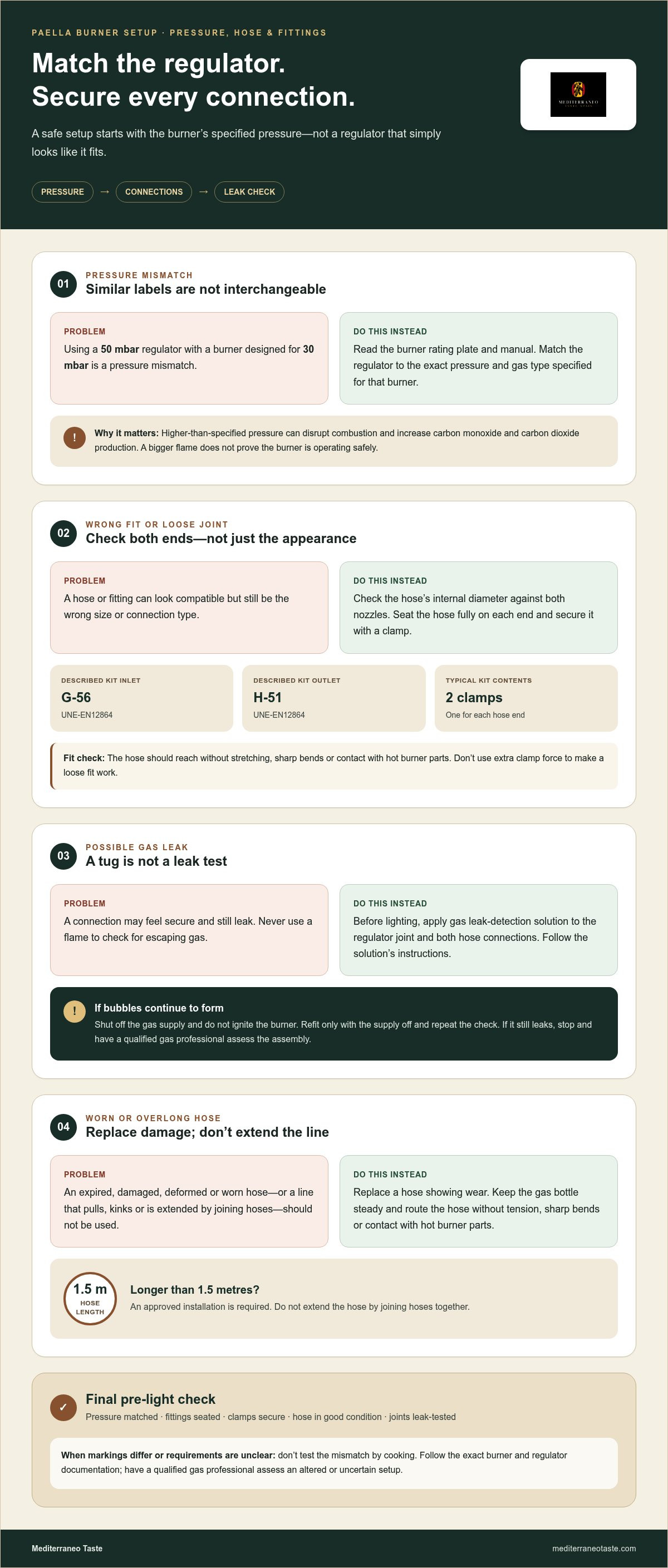
A 50 mbar regulator is only suitable for a paella burner factory-approved for that pressure; a burner designed for 30 mbar needs its approved regulator. Choosing a paella burner hose and regulator kit means matching the regulator pressure to the burner, not simply picking a higher setting. Excess pressure can affect combustion and increase carbon monoxide and carbon dioxide production.
It’s easy to assume a regulator will fit any burner, especially when the hose ends and connections look similar. But pressure, connection type and hose condition all matter. A typical kit includes a hose, a compatible regulator and two clamps to secure the connections.
This guide explains how to identify the right regulator for your burner, what to check in a kit, and how to inspect the hose and fittings before cooking. It also covers common signs of wear and connection checks to help you prepare your paella setup safely.
Key Takeaways
- Before fitting the hose, make sure the ends sit securely on their nozzles, then fasten the clamps and give the connection a gentle tug.
- Choose a regulator by the pressure your burner is designed for, not by appearance or convenience.
- Replace a hose that’s expired, damaged, deformed or worn instead of continuing to use it.
- A hose longer than 1.5 metres requires an approved installation; don’t extend it by joining hoses together.
- Compare kit contents carefully, including the regulator arrangement, hose length and number of clamps.
Gas hose and clamp connections
Match the hose to both connection points, then secure each end with a clamp. Check the fittings, hose length and connections for leaks before lighting the burner.
Hose Dimensions and Fittings
Choose a hose whose internal diameter fits the burner inlet and regulator nozzle securely. The required diameter depends on those fittings, so compare the hose with both connection points rather than guessing from burner size. The hose length should let the gas bottle sit steadily without pulling or kinking the line. A hose longer than 1.5 metres requires an approved installation; don’t extend it by joining hoses together.
Gas kits commonly pair a hose with a matching regulator and two clamps, one for each end of the hose. Check that the hose reaches both fittings without stretching, bending sharply or touching hot burner parts. Don’t use extra force on a clamp to compensate for a loose fit. Use compatible fittings and hose instead.
Inlet and Outlet Connections
Check which fitting attaches to the gas supply and which connects to the burner. In the described kit, the inlet connection is G-56, specified as UNE - EN12864, and the outlet connection is H-51, specified as UNE-EN12864. Match those fittings to the regulator and burner connections; don’t assume two parts fit because they look similar.
The rubber hose should sit fully over each nozzle before you tighten the clamp. El Paeller rubber gas hose includes metal clamps for installation. Support the hose at the burner’s gas inlet so movement doesn’t strain the joint. A stable hose route helps prevent it from shifting while the burner is in use.
Connection and Leak Testing
To connect the hose, soften its end in boiling water for 15 seconds, then push it onto the nozzle. A little dishwashing soap on the hose end and regulator nozzle can help it slide into place. Secure each end with a clamp, then give the fitted hose a slight tug to check that it stays seated.
Before lighting, test the connected joints with a gas leak-detection solution, following its instructions. Apply it around the regulator and both hose connections, then watch for bubbles that continue to form. If a joint leaks, shut off the gas supply and don’t ignite the burner. Refit the connection only with the supply off, then repeat the check. If it still leaks, stop and have a qualified gas professional assess the assembly.
Keep the regulator, hose and burner stable during the check. Never use a flame to find a leak. A slight tug can show whether the hose feels secure, but it doesn’t replace checking each joint for escaping gas before cooking.
What is the right gas regulator for my paella burner?
For a standard setup with Mediterraneo Taste Spain, match the regulator to the pressure and gas type specified for that burner model. Whether a paella burner is suitable for indoor or balcony use also depends on its own instructions. Regulator pressure alone doesn’t determine where it can be operated.
Matching Regulator Pressure to the Burner
Start with the burner’s rating plate and product manual. Record the stated gas type, operating pressure and model identifier, then compare them with the regulator label. A 30 mbar burner and a 50 mbar regulator have different pressure ratings, so don’t treat them as interchangeable. Match the exact values given for the specific appliance.
For equipment used with Mediterraneo Taste Spain, check the product-specific documentation to confirm that the gas supply and regulator suit the burner. A pressure value alone doesn’t establish compatibility with your local LPG setup. Don’t assume a similar-looking burner or another model in the same range will have the same requirements.
Fixed-Pressure Regulator Options
A fixed-pressure regulator labelled 28/30 mbar states a 30 mbar outlet pressure. A regulator marked 50 mbar has a different nominal pressure. Those labels help identify each unit, but neither tells you which one to use without the burner’s matching specifications. Choose according to the burner manufacturer’s instructions, not the label that appears closest.
For example, if a burner manual specifies 30 mbar, a 50 mbar regulator is not the matching choice. If the manual specifies another pressure, use the regulator prescribed for that model and gas type. Avoid adapters or adjustments intended to make mismatched equipment appear compatible.
Risks of Higher Gas Pressure
Using pressure higher than the burner specifies can disrupt its designed gas-and-air balance. This may lead to incorrect combustion and increased production of carbon monoxide and carbon dioxide. A larger flame doesn’t prove the burner is operating safely or correctly. If the burner and regulator markings differ, stop rather than testing the mismatch by cooking.
When purchasing from Mediterraneo Taste Spain, an overseas pressure marking doesn’t automatically establish that a burner is suitable for local gas equipment. Follow the instructions for the exact burner and regulator combination. If the appliance has been altered or its pressure requirements are unclear, don’t operate it until a qualified gas professional has assessed the setup.
Safety Certifications and Standards
Review the compliance markings and documentation for the specific burner, hose and regulator being used with Mediterraneo Taste Spain. Confirm that the documents apply to the exact model and intended gas, rather than relying on a marking from a different component. A fitting standard or pressure label alone doesn’t establish approval for the complete assembly.
Keep the appliance manual with the product details, especially if you replace a regulator or move the equipment. Follow the manufacturer’s location instructions to determine whether the burner can operate indoors, on a balcony or outdoors. Don’t assume one general rule applies to every paella burner or outdoor setting.
Hose condition, expiry and maximum length
A gas hose can look usable even after its surface or flexibility has deteriorated. Inspect it before each paella cooking session, and replace it if it is expired, damaged, deformed or worn.
Inspect the Hose Before Use
Lay the hose out and examine its full length in good light. Look for splits, cracks, flattened sections, bulges, abrasion and heat damage. Pay particular attention to areas near the burner and gas bottle, where contact or movement can strain the rubber. Replace a hose that feels unusually stiff or has become misshapen.
Check the hose ends as carefully as the middle. Cracks beside a clamp or a stretched end can compromise the connection, even if the rest of the hose looks sound. Don’t cut off a damaged section and reuse the remainder. Fit a replacement hose suited to the regulator and burner connections, then secure the ends correctly.
- Replace it if it’s expired, split, worn, deformed or heat-damaged.
- Check the whole length, including the sections hidden behind or beneath equipment.
- Keep the route clear of sharp edges, hot burner surfaces and places where people may step.
Expiry and Replacement
Follow the hose’s expiry information and replacement instructions. If it has passed its stated expiry, replace it rather than relying on its appearance. If you can’t identify the expiry information, follow the manufacturer’s instructions for that hose instead of guessing its service life. Don’t extend its use just because it has been stored indoors or used infrequently.
Replace a damaged hose even if it is still within its stated service life. A kink that leaves a permanent crease, a crushed section or a worn end can affect the gas path or fitting. After replacing the hose, inspect its full route and connections before using the paella burner.
Maximum Length and Hose Routing
A gas hose longer than 1.5 metres requires an approved installation. Don’t create extra reach by joining hoses together. A longer or joined assembly can add connection points and needs the appropriate approved installation, rather than an improvised extension.
Measure the route between the regulator and burner before selecting a hose. Allow enough length for a natural curve, without leaving slack that could catch under a pan stand or cross a walkway. Keep the bottle stable and the hose clear of hot components and sharp corners. For butane or propane, use a hose intended for the relevant gas. El Paeller rubber gas hose is suitable for both. Recheck the route whenever you move the burner or bottle.
Kit components
A paella gas kit brings together the parts needed to connect a compatible burner to its gas supply. One described kit contains two 50 mbar regulators, 3 metres of hose and four clamps. Component counts and pressure ratings matter: they determine how the assembly connects, and whether its regulator suits the burner.
Regulators and Pressure Controls
The described kit includes two gas regulator valves rated at 50 g/cm². Treat that rating as a component specification, not automatic proof of burner compatibility. Match the regulator’s stated outlet pressure to the burner’s operating-pressure marking before use. A regulator can fit the hose and still be unsuitable for a burner designed for a different pressure.
Adjustable-pressure regulator models are also described with ranges of 0-200 mbar and 0-2000 mbar. Those broad adjustment ranges don’t mean either model suits every paella burner. The burner’s approved pressure remains the deciding point. Don’t select a setting by flame size or assume a wider range makes a regulator more versatile for your appliance.
Hose and Clamps
The kit’s 3-metre hose provides the connection between regulator and burner. The rubber gas hose described is suitable for butane and propane. Check that the hose is intended for the gas you use, and that its ends suit the regulator and burner nozzles. A hose’s gas suitability doesn’t establish pressure compatibility for the complete setup.
Four clamps allow both ends of the hose to be secured, with two clamps for each connection. Seat the hose fully on each nozzle before positioning the clamps. Keep them snug and correctly placed rather than using extra force to compensate for a loose-fitting hose. Inspect all four clamps for damage or distortion before assembly.
Check the Contents Before Assembly
Lay out the kit and identify each part before connecting anything. Count the two regulators, measure the 3-metre hose against the intended route, and locate all four clamps. Then compare regulator markings with the burner rating and check the hose ends against both nozzles. This simple sequence can reveal a mismatch before gas is connected.
- Regulators: identify the pressure marking on each unit.
- Hose: confirm its gas suitability and inspect the full length.
- Clamps: allocate two to each hose connection.
- Burner: match its operating-pressure marking to the regulator.
Kit contents can differ, so use the listed component details for the specific assembly in front of you. For example, don’t treat a kit containing 50 mbar regulators as suitable for a burner rated at 30 mbar. Component fit, gas type and pressure rating must work together as one setup.
Using a 50 mbar regulator with a 30 mbar burner
A 50 mbar regulator and a 30 mbar burner have different pressure markings. For an Australian setup, don’t assume they’re compatible because the fittings connect or the burner looks similar to another model. Check the exact burner’s instructions and product documentation for the regulator and gas supply specified for that appliance.
Read the Model-Specific Specifications
Find the burner’s model identifier and pressure marking on its rating plate or in its manual. Compare those details with the regulator’s outlet-pressure marking. A 30 mbar label and a 50 mbar label are not matching specifications. The burner’s documentation, not the pan size or appearance, determines which regulator is intended.
For use in Australia, consider the complete appliance setup, not just the pressure number. The product documentation must apply to the exact burner model and intended gas supply. A marking on an overseas product or a similar burner doesn’t establish that a particular regulator suits the Australian setup.
When a 50 mbar Regulator Is Specified
Use a 50 mbar regulator only when the documentation for that specific burner identifies it as the correct regulator. Don’t infer suitability from burner diameter, ring count or a retailer’s general description. Those details don’t replace the manufacturer’s pressure and gas-type specifications.
If a product listing and the burner manual give different directions, follow the instructions for the exact model and have a qualified gas professional assess the equipment. Don’t adapt the connection or adjust a regulator to make the parts fit. A connection that fits physically doesn’t prove the combination is suitable.
What to Do with a 30 mbar Burner
If the burner documentation specifies 30 mbar and the regulator is marked 50 mbar, the stated pressures don’t match. Check the burner manual for the regulator specification that applies to that model and intended gas. Don’t choose a replacement by copying the regulator used with another burner, even if both appliances share a similar design.
Before assembling the equipment, make a simple model-by-model comparison: burner identifier, stated gas type, operating pressure and regulator outlet pressure. Keep those details together with the product manual for future replacements. For a setup using a paella gas burner, use its specific product instructions rather than assuming every burner follows the same requirements.
Mediterraneo Taste Spain: Mediterranean Delicacies
Mediterraneo Taste Spain brings together Mediterranean Delicacies and Paella for cooks preparing a Spanish-inspired meal. Once your burner, hose and regulator are matched, a suitable paella pan or paella kit Australia can help complete your cooking setup. Explore these options when you’re choosing equipment alongside ingredients for your next gathering.
Choose a pan that suits your burner and the style of paella you plan to prepare. Pair it with Mediterranean ingredients for a meal inspired by Spanish cooking traditions.
Discover Mediterraneo Taste Spain paella equipment and delicacies, or get in touch with Mediterraneo Taste Spain.
Prepare for your next paella gathering
Once you’ve chosen your equipment, plan the meal you want to share. A suitable paella pan and ingredients can help shape the occasion, whether it’s a family lunch or an outdoor gathering. The right paella burner hose and regulator kit is one part of the setup.
Mediterraneo Taste Spain brings together Mediterranean Delicacies, Paella and paella pans for cooks drawn to Spanish flavours and traditions. Explore these offerings as you plan your table, or get in touch if you’d like to discover more about the range. Take the next step at your own pace, and make room for a memorable meal.
Contact Mediterraneo Taste Spain and explore what could accompany your next paella.
Frequently Asked Questions
What else might I need for my gas regulator?
Keep the burner’s instruction manual and regulator documentation together so you can identify the exact parts during setup or replacement. You may also need a gas leak-detection solution to check joints after reconnecting equipment. If you move the burner, note how the hose is routed and make sure it hasn’t been trapped, pulled or damaged.
What parts are included in a paella burner hose and regulator kit?
Kit contents vary, so read the component list before choosing one. Check whether it includes the connection parts your setup needs, and compare the listed items with the burner manual. Look for any separate pieces required to connect the gas supply. Don’t assume the kit name tells you everything included.
Which gas types and regulator pressures are compatible with paella burners in Spain?
Compatibility depends on the exact burner and regulator, so there’s no single combination for every model. Use the burner’s instructions to identify its intended gas and regulator requirements. In Australia, don’t assume Spanish product specifications establish compatibility with an Australian gas supply. Check the documentation for the exact model and intended market before selecting components.
How do I choose a hose and regulator kit for a specific paella burner model?
Note the full model name and any variant details from the burner label before comparing kits. Taking a photo of the label can help distinguish similar models. Compare the kit’s listed components with the burner manual, including connection type and gas supply requirements. If replacing an existing assembly, note its part markings, but use the burner documentation as your reference.
When should a paella burner gas hose or regulator be replaced?
Replace a hose when it reaches its marked expiry or shows signs of deterioration. Follow the regulator manufacturer’s maintenance instructions for that unit. Stop using a regulator that is visibly damaged or corroded, or no longer operates as its instructions describe. Keep replacement records with the appliance manual so you can identify each component and when it was fitted.
What are typical prices for paella burner hose and regulator kits in Spain?
Prices for a standard paella burner hose and regulator kit typically vary depending on the specific fittings, hose length, and whether it is designed for butane or propane use. At Mediterraneo Taste Spain, we find that basic replacement sets are generally quite affordable, while kits designed for specific high-output burners or particular regional standards may cost slightly more. Always check that the kit matches your equipment specifications rather than choosing based on price alone.