

Spain’s olive oil is defined by remarkable variety: more than 200 olive varieties are grown across the country, each bringing its own character to the table. The gourmet Spanish olive oil varieties you encounter may taste gently fruity and sweet, or green, peppery and pleasantly bitter.
Choosing a bottle can feel like a balancing act. You want an oil that suits your palate and how you’ll use it, whether drizzled over ripe tomatoes or added to a favourite dish. Tasting notes offer a helpful guide: Arbequina is typically soft and fruity, while Picual is more intense, with distinctive bitterness and spice.
Explore what sets Spanish olive oil apart, discover the flavours of its best-known varieties and learn how to match an oil to your table. You’ll also find practical guidance on choosing extra virgin olive oil and storing it to help preserve its fresh character.
Key Takeaways
- Use a variety’s regional origin and tasting notes to narrow down the style that suits your palate.
- Choose Cornicabra when you enjoy an aromatic oil with a more pronounced bitter and peppery edge.
- Match the oil’s intensity to the dish: a bolder variety can stand up to robust flavours, while a gentler one suits delicate foods.
- For everyday use, look for extra virgin olive oil in a dark glass bottle or tin, then store it away from direct sunlight.
- Explore beyond the best-known varieties to discover the distinct flavours Spain’s olive-growing regions offer.
1. What Makes Spanish Olive Oil Unique?
Spain’s olive oil character begins with its landscape. Andalusia produces around 80% of the country’s olive oil, while Spain accounts for about one-third of global production. That scale doesn’t create a single flavour profile. Regional climate, local varieties and growing traditions shape oils with distinct aromas and levels of bitterness. Jaén, in eastern Andalusia, is a key example: its protected designations connect particular oils with defined places and production standards.
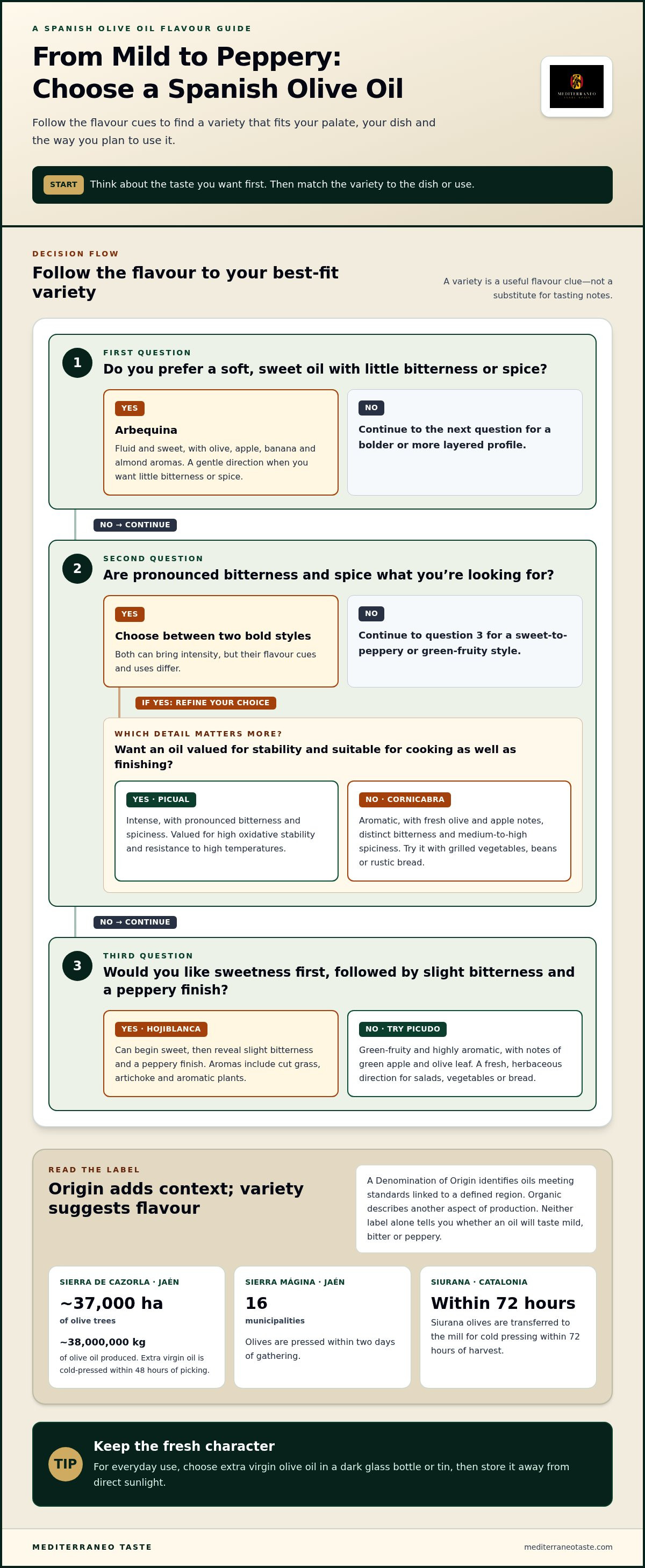
Jaén’s Sierra de Cazorla designation covers around 37,000 hectares of olive trees and produces approximately 38,000,000 kg of olive oil. Its extra virgin oil is extracted by cold pressing within 48 hours of picking. Nearby, Sierra Mágina olive oil comes from 16 municipalities in Jaén province, where olives are pressed within two days of gathering. These regional details help explain how place and handling contribute to an oil’s identity, beyond the variety named on a bottle.
Castilla-La Mancha offers another distinctive thread. Cornicabra cultivation is concentrated mainly between Madrid and Castilla-La Mancha, and it ranks second among Spanish varieties by cultivated area. In La Alcarria, the Designation of Origin accepts Castellana as the only variety for extra virgin olive oil carrying its label. This close link between origin and permitted variety gives the designation a clear regional identity, connecting the oil to a particular landscape and olive.
Other designations show how varied Spain’s producing regions can be. Sierra de Cádiz has 20,000 hectares of olive trees, and Verdial from Huévar is one of the varieties admitted under its designation. In Catalonia, Siurana olives are transferred to the mill for cold pressing within 72 hours of harvest. These examples offer a practical way to explore: look for a named region, then note its approved varieties and handling details.
A designation of origin protects and certifies oils that meet specified standards. It can help shoppers understand geographical origin and production, while the olive variety suggests possible aromas and flavours. Neither label replaces tasting notes. For example, Farga extra virgin oils are associated with almond and walnut notes, offering a flavour clue linked to a regional variety. Organic describes another aspect of an oil, so read each label for the information relevant to your choice.
2. Cornicabra’s aromatic and slightly bitter oils
Cornicabra brings a vivid, layered character to Spanish olive oils. Its aromas can suggest fresh olives and apple, while its taste moves from fruitiness to a distinct bitter note. That bitterness is not a flaw, but part of the variety’s signature. Cornicabra oils can also have medium to high spiciness, leaving peppery warmth at the back of the throat. Taste a little on its own, then notice how the fruit, bitterness and spice develop.
Cornicabra’s intensity suits dishes that can take an assertive finish. Try it over grilled vegetables, beans or rustic bread, where its green, aromatic notes will stand out. A light drizzle can also lift a tomato salad without masking the ingredients. In cooked dishes, use it when you want the oil to contribute flavour as well as richness. Start sparingly, taste, then add more if its bitter and peppery notes suit the dish.
Other varieties offer a different balance. Arbequina is fluid and sweet, with aromas of olive, apple, banana and almond, and little bitterness or spice. Hojiblanca can begin sweet, then reveal slight bitterness and a peppery finish, with aromas of cut grass, artichoke and aromatic plants. Picual is more intense, with pronounced bitterness and spiciness. Valued for its stability, it can work in cooking and as a finishing oil. These contrasts make variety a practical starting point when choosing an oil for a recipe.
Picudo offers another aromatic direction. Its oils are green-fruity, with notes of green apple and olive leaf, and are also described as fruity, herbaceous and highly aromatic. Try Picudo when you want fresh green notes alongside salads, vegetables or bread. Compare it with Cornicabra: both can feel lively, but Picudo’s green-fruit profile offers a distinct tasting experience.
Organic and protected-designation labels tell you different things. Organic describes how a product is produced, while a Spanish Denomination of Origin identifies oils that meet standards linked to a defined region. Neither label alone tells you whether the flavour will be mild, bitter or peppery. Use the variety and tasting notes to judge flavour, then consider designations as additional information about production and origin.
For a simple tasting, pour a little oil onto plain bread and compare the varieties side by side. Notice which aromas arrive first, how strongly bitterness registers, and whether the finish feels peppery. If you’re preparing paella, explore Spanish saffron for paella alongside your oil choice, then use the oil’s flavour profile to complement the other ingredients.
3. Spanish olive varieties: Picual, Arbequina, Hojiblanca and Cornicabra
Picual is Spain’s most abundant olive variety, and its trees cover approximately 900,000 hectares of production area. Its oil is known for an intense taste, with noticeable bitterness and spice. That bold profile makes Picual easy to recognise in a tasting: look for a firm green-fruit character, then note the peppery finish. The variety also has practical strengths beyond flavour.
Picual oil is valued for high oxidative stability and resistance to high temperatures. It suits cooking as well as finishing, so one bottle can move between the pan and the table. Use it in a cooked dish when you want its character to remain present. For a final drizzle, start with a little over vegetables or bread, then taste how its bitterness and spice interact with the other ingredients.
Arbequina offers a gentler contrast. It is characteristic of Catalonia, particularly Tarragona and Lleida, and Alto Aragón, though it now grows across almost all of Spain. Its oil is fluid and sweet, with fruity aromas of olive, apple, banana and almond. Bitterness and spiciness are usually scarce. Try Arbequina when you want fruitiness without a strong peppery finish, such as over mild vegetables or with bread as a table oil.
Hojiblanca is well established in Andalusia, and its name is associated with leaves whose undersides appear white. The olives are used both for oil and as table olives. Hojiblanca oil can open sweet, with aromas of freshly cut grass, artichoke and aromatic plants, followed by slight bitterness and a peppery finish. This changing profile makes it a useful middle ground between sweeter Arbequina and more forceful Picual.
Cornicabra gives another clear point of comparison. Its oils are highly aromatic, with fruity olive and apple notes alongside medium to high bitterness and spiciness. The variety’s growing area is concentrated mainly between Madrid and Castilla-La Mancha. If you enjoy a lively finish, Cornicabra can bring aromatic depth to a simple meal. Compare a little with Arbequina: one leans sweet and soft, the other more bitter and peppery.
To choose among these four, taste them side by side with plain bread. First notice the fruit, then compare the bitterness and spice in each oil’s finish. Picual brings intensity and stability; Arbequina offers sweetness; Hojiblanca balances a sweet start with a peppery finish; Cornicabra delivers aromatic fruit and a stronger bitter edge. Match the profile to your preference, then consider whether you want the oil to lead the dish or quietly support it.
4. Choosing and storing extra virgin olive oil
How much does gourmet Spanish extra virgin olive oil cost in Spain? There’s no single price: variety, origin, production method, organic status, designation and bottle size all affect the shelf price. Compare oils by package size and stated characteristics rather than assuming a higher price guarantees a flavour you’ll prefer.
Counterfeit or misleading labels can mean paying for an origin, variety or production claim that the oil doesn’t deliver. The practical risk is a mismatch between the label and what’s in the bottle, so clear origin details and trustworthy packaging are useful clues.
For general use, choose extra virgin olive oil, ideally cold-pressed and sold in dark glass or a tin. Cold extraction describes how oil is obtained from olives, and careful handling matters to the resulting quality. Check the variety and origin as well as the grade. Arbequina, for example, can offer a gentler, fruitier profile than a more bitter option. A named Sierra origin or protected designation adds regional context, while organic labelling describes a separate production attribute.
Cold-pressed wording can help you compare production methods, but it doesn’t tell you everything about flavour or freshness. Read the full label, including the variety, region and any designation, then match the tasting notes to your intended use. Choose a mild, fruity oil for delicate dishes, or a more robust profile when you want the oil’s character to stand out. If you’re choosing between two bottles, compare their notes and pick the one that suits your table.
Protect the oil after opening. Keep the bottle or tin away from direct sunlight and close it securely after each pour. Dark glass or a tin limits exposure to light, while a cupboard away from a sunny window offers a simple storage spot. Avoid leaving the bottle beside a hot hob or in a warm, bright place. These habits help preserve the oil’s aroma and taste.
Use the label as a practical checklist: confirm the extra virgin grade, note the olive variety and origin, and choose packaging that shields the oil from light. Store it consistently rather than displaying it on a sunlit counter. Whether you choose Arbequina for gentler fruitiness or another Spanish oil with a bolder profile, look for a flavour and stated origin that suit how you cook and eat.
5. Spain’s diversity of olive varieties
More than 200 olive varieties grow in Spain, giving its Mediterranean oils a wide range of character. Each variety reflects a combination of growing region and inherited traits, from fruitiness to bitterness. For shoppers, this means a label’s variety name can offer a useful first clue, but it doesn’t tell the whole story. Look at the growing area too. A regional name can help connect the oil’s flavour profile with the landscape behind it.
Some varieties have clear regional homes. Empeltre is typical of Aragón and also grows in the Balearic Islands, Castellón, Tarragona and Navarre. Morrut is associated with Baix Ebre-Montsià, near the Castellón and Tarragona border, where it is also called “morruda”. These names show how olive growing crosses provincial boundaries. When exploring Spanish oils, consider variety and place together to discover a region’s particular style.
Some olives show why oil and table use don’t always overlap. Gordal Sevillana is grown mainly in Seville and prized as a large table olive. It is not generally used for oil because its fat yield is very low. Hojiblanca, by contrast, is used both for oil and as a table olive. These examples show that an olive variety’s culinary role depends on its characteristics, not simply where it grows.
Several less familiar varieties offer distinctive flavour cues. Royal is native to Jaén province and grows in its northern mountain range; its oils are sweet and fruity, with fig notes. Blanqueta grows particularly in Alicante, as well as Valencia, Murcia and Albacete. Its oils are intensely fruity, bitter and peppery. Picudo is grown in Córdoba, Granada, Málaga and Jaén, with green-fruit notes such as apple and olive leaf. Each offers a different route into Spain’s regional palate.
Use variety names as a tasting map, not a promise that every bottle will taste identical. Start with the province or growing area, then compare the producer’s description with your own preference. Choose Royal if sweet fruit and fig notes appeal; consider Blanqueta if you enjoy intense bitterness and spice. A side-by-side tasting with bread helps reveal the contrasts. Spain’s range of varieties offers more to explore than familiar names alone.
Mediterraneo Taste Spain: Mediterranean Delicacies
Mediterraneo Taste Spain offers Mediterranean delicacies and paella products to bring Spanish flavours to your table. After exploring olive varieties, pair an oil’s fruity, peppery or gently bitter character with complementary ingredients. A drizzle can finish a dish, while a suitable paella pan and ingredients help you prepare a Spanish meal at home.
When you’re ready to explore Mediterranean ingredients or prepare paella, discover Mediterraneo Taste Spain’s range of delicacies, paella pans and kits, and choose what suits your cooking plans. Let the olive oil’s origin and flavour guide your pairing, then bring those regional notes into a meal to share.
Explore mediterraneotaste.com or contact Mediterraneo Taste Spain to find your next Spanish cooking inspiration.
Let your next tasting shape the menu
Make your next bottle part of the meal, not just an ingredient on the shelf. Pour a little into a tasting dish, try it with bread, then decide which aromas and finish you’d like at the table. This simple ritual turns choosing among gourmet Spanish olive oil varieties into a personal discovery, guided by your palate rather than the label alone.
From there, build a meal around the flavour you enjoy. A lively, peppery oil can inspire a bolder pairing, while a softer one may suit a more delicate plate. Keep exploring Spanish food traditions, and let each ingredient suggest a different combination. There’s no need to settle on one favourite; the pleasure is finding the right match for the moment.
Ready to bring more Spanish flavour into your kitchen? Explore Mediterraneo Taste Spain and find inspiration for your next meal. Enjoy the discovery, and savour every drizzle.
Frequently Asked Questions
What Makes Spanish Olive Oil Unique?
Spain’s olive oils reflect a broad mix of cultivars, landscapes and local traditions. The same country offers oils with soft fruitiness, herbal aromas or a distinct bitter, peppery finish. For a regional tasting, compare oils associated with Jaén and Castilla-La Mancha, then note how their olive varieties shape the experience. Origin adds context, while cultivar and tasting notes help you judge whether an oil will suit your palate.
What is considered the best olive oil in the world?
There is no single best olive oil for every palate or purpose. One taster may favour a sweet, gentle oil, while another prefers pronounced bitterness and spice. Rather than relying on a universal ranking, consider freshness, production details, origin and tasting notes. Choose a mild oil for delicate ingredients or a more intense one when you want its flavour to stand out. Personal preference is the deciding factor.
What are the main gourmet Spanish olive oil varieties and their flavour profiles?
Spain’s familiar oil varieties include Picual, Arbequina, Hojiblanca and Cornicabra, with other regional cultivars adding further character. Arbequina tends towards soft fruitiness; Picual is more intense. Hojiblanca can combine a sweet opening with herbal notes and a peppery finish, while Cornicabra brings aromatic fruit with bitterness and spice. Use these descriptions as a guide, then compare oils with plain bread to find the profile you enjoy most.
Which Spanish olive cultivars are best for extra virgin olive oil?
No single cultivar is best for every extra virgin olive oil. Picual is valued for stability and robust flavour, while Arbequina offers a softer, sweeter profile. Hojiblanca and Cornicabra provide aromatic alternatives, each with its own balance of fruit, bitterness and spice. The right choice depends on the intended use and the flavour you want. Compare single-variety oils before exploring blends, which bring cultivars together.
What are the differences between Picual, Arbequina, Hojiblanca, and Cornicabra oils?
Picual is the boldest of this group, with notable bitterness and spice. Arbequina is generally sweeter and fruitier, with little bitterness or pungency. Hojiblanca offers a changing profile, often starting sweet before a lightly bitter, peppery finish. Cornicabra is aromatic, with fruity olive and apple notes alongside stronger bitterness and spice. To compare them, taste small pours in sequence, starting with the gentlest profile.
Which Spanish regions and protected designations of origin produce notable gourmet olive oils?
Notable regional examples include Sierra de Cazorla and Sierra Mágina in Jaén, La Alcarria in Castilla-La Mancha, and Sierra de Cádiz in Andalusia. Each designation links oil to a defined origin and production standards. Look for the designation name on the label, then consider the cultivar and tasting description. Together, these details give a more useful picture of the oil than a regional name alone.
What quality grades and certifications apply to Spanish olive oil?
Labels may identify olive oil grades such as extra virgin or virgin, while a Denomination of Origin identifies oils that meet standards tied to a specific region. Organic labelling concerns production, not a particular flavour or olive cultivar. Read these claims separately: grade describes the oil category, a protected designation signals regional standards, and organic status refers to production. For flavour, also check the variety and producer’s tasting notes.
How can I choose Spanish olive oil for tasting, cooking, or gifting?
For a tasting, choose oils with contrasting varieties or origins, then sample them with plain bread so their differences are clear. For cooking, match intensity to the dish: a pronounced oil can complement hearty ingredients, while a gentler one suits delicate flavours. As a gift, look for a clearly described origin and attractive, protective packaging. A selection with different profiles makes an inviting introduction to Spain’s varied olive-growing regions.