

The appeal of spanish sea salt flakes is clearest when they meet the food. Their delicate, irregular crystals can add a crisp finish and small bursts of salt, making them especially useful as a last-minute sprinkle.
Flakes are more than a decorative alternative to fine or coarse salt. Crystal shape affects how salt lands on the palate, and timing determines whether you notice the crunch. Use them with a light hand: they still add sodium, so let their texture do the work instead of adding a heavy pinch by habit.
This guide compares sea salt flakes with everyday salt, explains when to use them during cooking or as a finishing touch, and shows what labels can tell you about origin and product claims. You’ll also learn how “flor de sal” differs from other flakes and how to choose and store a salt that suits your cooking. Attention to texture, timing, and restraint can bring a more considered finish to Mediterranean dishes.
Key Takeaways
- Spanish sea salt flakes are distinguished by their crystal form and crisp texture, though these qualities vary between products.
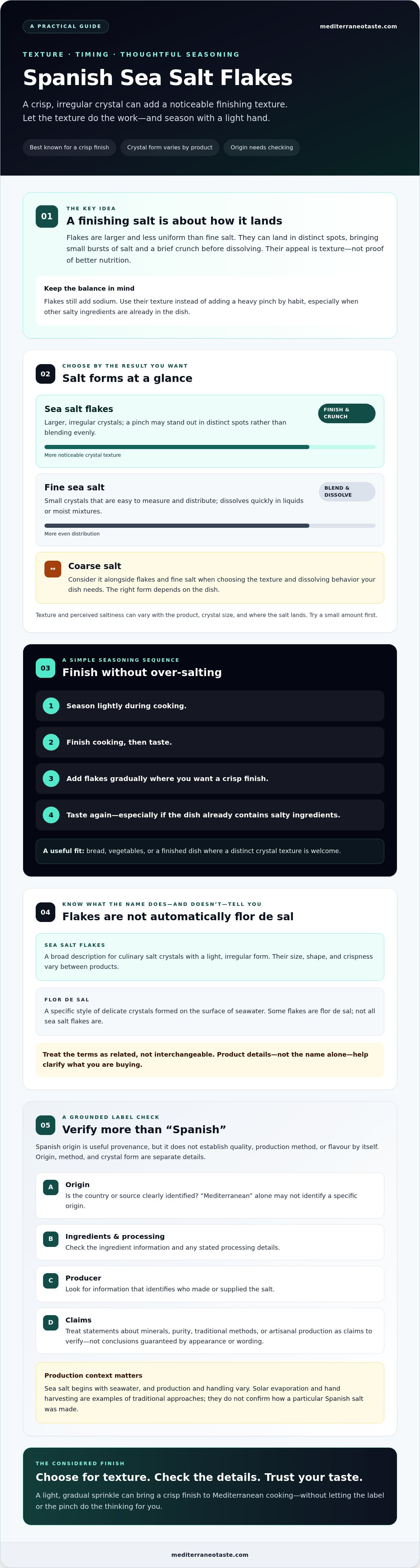
- Choose flakes, fine salt, or coarse salt according to the texture and dissolving behavior your dish needs.
- Season lightly, finish cooking, taste, then add flakes gradually, especially when the dish already includes salty ingredients.
- Check the stated origin, ingredients, producer information, and crystal form rather than relying on broad product claims.
- Use your own taste as a guide: thoughtful ingredient choices can bring a more considered finish to Mediterranean cooking.
What Are Spanish Sea Salt Flakes, and What Makes Their Texture Distinctive?
Sea salt flakes are culinary salt crystals with a light, irregular form. They season food and are often valued for the texture they add as a finishing touch. Spanish sea salt flakes are flakes presented as originating in Spain, but the name alone doesn’t confirm a particular producer, harvesting method, or flavour profile. Check the product details rather than assuming every salt sold under this description is made in the same way.
Flakes may look thin, layered, or uneven, but their size and shape vary. Their crispness can add a brief crunch before they dissolve on the tongue. Some flakes are a type of flor de sal, formed as delicate crystals on the surface of seawater; Fleur de sel describes this specific style. Not all sea salt flakes are flor de sal, so treat the terms as related, not interchangeable.
Perceived saltiness and flavour depend on the product, crystal size, and where the salt lands. A larger crystal may give a more distinct salty burst, while fine grains spread more evenly. Neither texture nor origin alone tells you how a salt will taste in a particular dish. Try a small amount first.
How do sea salt flakes differ from fine sea salt?
Fine sea salt has small crystals that are easy to measure and distribute through food. It dissolves quickly in liquids or moist mixtures. Flakes are larger and less uniform, so a pinch may land in distinct spots rather than blending evenly. That contrast can make them noticeable on bread, vegetables, or a finished dish. The difference is texture and use, not proof that flakes are healthier or more nutritious.
Does Spanish origin tell you everything about a salt?
No. A stated Spanish origin is useful provenance, but it doesn’t establish quality by itself. Look for a clearly named origin and producer, along with specific ingredient information rather than broad promotional language. Claims about harvesting, minerals, or production should be supported by product details you can verify. For a wider provenance checklist, consult the buyer’s guide, “How to Spot Truly Authentic Spanish Ingredients.” Choose based on the information available and the texture you enjoy, not origin alone.
How Spanish Sea Salt Flakes Are Made and What to Verify About Their Origin
Sea salt begins with seawater, but the route from water to crystal varies by producer. Salt may be obtained as water evaporates and crystals form, with production and handling differing by place and method. Some traditional approaches use solar evaporation and hand harvesting; the University of Hawaii’s overview of traditional salt harvesting methods explains one example. It doesn’t confirm how a particular Spanish salt is made.
Origin, production method, and crystal form are separate details to verify. A Spanish origin statement tells you something about provenance, but doesn’t automatically say where the salt was harvested, how it was processed, or what its flakes will taste like. When choosing spanish sea salt flakes, look for details that connect the product to a specific source and producer rather than treating evocative packaging as proof.
Which label details help assess Spanish sea salt flakes?
Check the label for a clearly stated country of origin, an ingredient list, and any available information about processing or the producer. If the pack says “Spanish,” see whether it gives more precise sourcing details. Broad phrases such as “from the Mediterranean” may sound appealing but don’t identify a specific origin. Treat claims about purity, mineral content, or traditional methods as claims to verify, not conclusions you can draw from the salt’s appearance.
What does artisanal or natural mean on a salt label?
Words such as “artisanal” and “natural” may describe a product’s character, but without context they don’t tell you its precise method, source, or flavour. Look for supporting information: who produced it, where it came from, and what the maker says about its handling. Don’t assume these terms guarantee a particular taste or quality. Compare the available details, then decide whether the product suits your cooking and preferences.
A simple label check keeps the decision grounded:
- Origin: Is the country or source clearly identified?
- Ingredients: Is the salt described plainly, with processing information where provided?
- Producer: Can you identify who made or supplied it?
- Claims: Are statements about minerals or methods explained with specific details?
Choose with curiosity, not assumptions. For inspiration on pairing carefully selected ingredients with Spanish home cooking, explore Mediterranean delicacies and Spanish food products.
Spanish Sea Salt Flakes vs. Fine Salt: Which Form Suits the Dish?
Choose salt by the effect you want. Fine salt blends into a dish quickly and evenly, while flakes can add a distinct crunch when sprinkled just before serving. Coarse salt also has larger crystals, but it’s often more useful in a grinder or in recipes where a slower dissolve suits the dish. Crystal size changes how salt is distributed, not the amount of salt your food ultimately contains.
Form: Flakes
Texture and dissolving: Irregular crystals; may stay crisp on a dry surface, but soften in moist food.
Typical use: Finishing vegetables, grilled foods, salads, or bread.
Form: Fine salt
Texture and dissolving: Small crystals disperse evenly and dissolve quickly.
Typical use: Mixing into sauces, doughs, or other dishes where even seasoning matters.
Form: Coarse salt
Texture and dissolving: Larger crystals; dissolving depends on the recipe and how they’re used.
Typical use: Grinding or adding where a more gradual dissolve is suitable.
A pinch of flakes and a spoonful of fine salt aren’t automatically equivalent by volume. Crystal size and how evenly salt reaches the food affect the impression of seasoning. For broader context on taste, texture and processing, Mayo Clinic Health System discusses how sea salt and table salt compare. Don’t assume flake salt is healthier because it looks less refined; choose the form for its role in the dish.
When are flakes better as a finishing salt?
Use flakes when you want their texture to remain part of the bite. Sprinkle a small pinch over grilled vegetables, a salad, fresh bread, or grilled foods just before serving. Taste first, then adjust gradually. Added too early, flakes may dissolve and lose their crisp contrast. Added at the end, they can create small, noticeable bursts of seasoning.
Can you cook with Spanish sea salt flakes?
Yes. Flakes can season food during cooking, but they’ll dissolve in liquid or moist mixtures, so their crunch won’t remain. Choose fine salt when quick dissolution or even distribution is the priority. For a wider look at how ingredients come together in Spanish cooking, explore Mediterranean delicacies and Spanish food products.
Use spanish sea salt flakes for the finish when texture matters. Choose another form when the recipe calls for seasoning to disappear into the dish. Let the food, not the label, guide your choice.
How to Use Spanish Sea Salt Flakes Without Over-Salting
Finishing salt works best as a final adjustment, not a substitute for tasting. Season the dish lightly while it cooks, then finish cooking and taste the complete result. Consider salty ingredients already in the recipe, such as olives, cheese, cured foods, or anchovies, before adding more. If the dish needs it, add a small pinch of flakes and taste again before adding another.
Moisture affects the finish. On a dry or lightly oiled surface, flakes may stay more distinct. On juicy tomatoes or food with a wet dressing, they can soften and dissolve sooner. Sprinkle evenly rather than dropping a heavy cluster in one spot. Aim for a gentle contrast, not a salty mouthful.
How should you season a dish with finishing flakes?
Start with a small pinch spread across the surface. Let the food’s own flavour come through, then taste a bite that includes both the topping and the base. A final pinch can bring a crisp, savoury accent, but more isn’t always better. Add gradually, especially if the dish has reduced during cooking and its flavours have become more concentrated.
Which Mediterranean dishes can benefit from a finishing pinch?
Try a light sprinkle over ripe tomatoes, grilled vegetables, simply cooked fish, or warm bread. The flakes can contrast with the sweetness of ripe produce, the char of grilled vegetables, or the soft crumb of bread. With fish, keep the pinch modest so it complements rather than masks the natural flavour. Choose one or two dishes to test, then adjust to your taste.
Keep spanish sea salt flakes dry between uses. Close the container firmly and store it away from steam, splashes, and other sources of moisture. If the crystals clump or soften, they may no longer give the crisp finish you want.
For ideas on pairing complementary ingredients in Mediterranean cooking, explore Mediterranean delicacies and Spanish food products.
Choosing Spanish Sea Salt Flakes and Exploring Mediterranean Ingredients
Start with how you plan to use the salt, then consider what the label can genuinely tell you. Spanish sea salt flakes aren’t automatically right for every dish, and no single style suits every palate. Look for clear sourcing and a crystal form that fits your cooking instead of relying on premium sounding language alone.
What should you consider before choosing a salt product?
Use this checklist to compare options:
- Origin: Look for a clearly stated country and, where available, more specific sourcing information.
- Ingredients: Read the list and check whether it explains what the product contains.
- Producer details: Information about who made or supplied the salt helps you assess its provenance.
- Crystal form: Consider whether the flakes suit sprinkling at the table or whether a finer texture would work better for your usual dishes.
- Production claims: Look for context behind descriptions of processing or harvesting. Don’t treat evocative wording as evidence on its own.
Compare details you can verify. Words such as “artisanal,” “natural,” or “pure” may sound appealing, but they don’t explain a product’s origin, production, or flavour by themselves. If those qualities matter to you, seek specific information from the label or producer. For more on assessing provenance across Spanish food products, see How to Spot Truly Authentic Spanish Ingredients.
How can salt flakes complement a Mediterranean pantry?
Think of flakes as one finishing option among many, not a pantry essential or a universal upgrade. Their larger crystals can add a final textural accent, while other ingredients bring their own aromas and character. The right balance depends on the food and your taste: some cooks enjoy a noticeable crunch, while others prefer salt to dissolve into the dish.
Choose a crystal form that suits the meals you make, and try a small amount before deciding whether it belongs in your regular routine. Thoughtful ingredient selection is part of the pleasure of Mediterranean cooking, but there’s no need to buy a product just because its description sounds luxurious.
Explore Mediterranean delicacies for inspiration as you build a pantry around the flavours and ingredients you enjoy.
Bring a More Thoughtful Finish to Your Cooking
The appeal of spanish sea salt flakes lies in their texture and timing, not origin alone. Check the product’s provenance and label details, then match its crystal form to the dish. Use flakes near serving when you want a crisp finish. Season sparingly, taste the complete dish, and account for salty ingredients before adding more.
There’s no single best salt for every kitchen or palate. Fine salt can suit even seasoning during cooking, while flakes offer a different finishing touch. A little care helps each ingredient keep its place in the final flavour.
Explore Mediterranean delicacies and Spanish food products from Mediterraneo Taste Spain for inspiration as you bring considered ingredients to your table.
Frequently Asked Questions
What are Spanish sea salt flakes?
Spanish sea salt flakes are culinary salt crystals sold as originating in Spain, with a flaky form often used to season or finish food. Their size, shape, crunch, and flavour can differ by product, so don’t assume every pack has the same characteristics. Some flakes are described as flor de sal, but the terms aren’t interchangeable. Check the product description to understand what type of salt you’re choosing.
Are Spanish sea salt flakes different from regular sea salt?
They can differ in crystal shape and texture, but “regular sea salt” covers products in several forms. Fine sea salt spreads readily and dissolves quickly, while flakes can remain noticeable as a finishing touch. The name “Spanish” refers to stated origin, not a guaranteed taste or production method. Compare the label and crystal form, then choose according to how you want the salt to behave in your dish.
Can you use sea salt flakes for cooking?
Yes, sea salt flakes can season food during cooking, but their crunch usually fades as they dissolve in moist ingredients or liquids. You can use them in a sauce or cooking water if that is the form you have, but fine salt may be easier to distribute evenly. For a distinct crystal texture, reserve flakes for the surface and add them near serving. Taste before adding more.
How much sea salt should you use to finish a dish?
Start with a small pinch, scatter it lightly, then taste a complete bite before adding more. There’s no universal amount because crystal size, dish size, and existing seasoning all affect the result. Check for salty ingredients such as olives, cheese, anchovies, or cured foods first. Add flakes gradually and stop when they provide a pleasant contrast without taking over the dish.
What foods pair well with Spanish sea salt flakes?
Spanish sea salt flakes can add a crisp finishing accent to ripe tomatoes, grilled vegetables, simply cooked fish, salads, and bread. Use a light hand so the crystals complement the food’s own flavour rather than overpowering it. Juicy or dressed foods may soften flakes more quickly, while drier surfaces can preserve more crunch. Try a small pinch, taste, and adjust to your preference.
How should you store sea salt flakes?
Store sea salt flakes in a tightly sealed container in a cool, dry place, away from steam, splashes, and damp utensils. Moisture can cause crystals to clump or lose their crisp texture, making them less enjoyable as a finishing salt. Close the container after each use, and avoid sprinkling directly over a steaming pot if condensation could enter the pack.
How can you tell whether Spanish sea salt flakes are authentic?
Check that the packaging clearly states Spanish origin, and look for specific sourcing details and information about the producer. Read the ingredients and any description of processing, but treat claims such as “artisanal,” “pure,” or “traditional” as prompts to look for evidence, not proof by themselves. A broad Spanish claim doesn’t identify a particular source or guarantee a specific flavour, texture, or production method.