

The sharper vinegar isn’t always the one that tastes most forceful. Aged sherry vinegar for cooking is made from sherry wine and matured in oak barrels; its acidity is typically 7% to 8%, while its pH tends to be closer to 4. Those figures describe different measures, so a vinegar’s acidity percentage doesn’t tell the whole story about how it tastes.
If you’re wondering what sherry vinegar is, think of a Spanish vinegar with a rounded, savoury character shaped by its wine base and ageing. It can add brightness and depth without the sharp impression of some wine vinegars, and is generally less sweet than balsamic.
Here, you’ll learn how acidity compares with other vinegars, what Reserva and Gran Reserva mean, and how grape variety and ageing affect flavour. You’ll also find practical ideas for dressings, vegetables, sauces and pairings, helping you choose a style and use it with confidence.
Key Takeaways
- Acidity percentage and pH describe different things, so neither alone tells you exactly how sharp a vinegar will taste.
- Compare sherry vinegar with wine, cider and rice vinegars to find a flavour that suits your dish.
- Look for ageing terms such as Reserva and Gran Reserva to understand how long the vinegar has matured.
- Use its savoury depth to brighten dressings, vegetables and sauces, adding it gradually to balance the dish.
- Pair the vinegar’s grape and ageing character with ingredients that welcome a rounded, tangy finish.
How aged sherry vinegar’s acidity compares with other vinegars
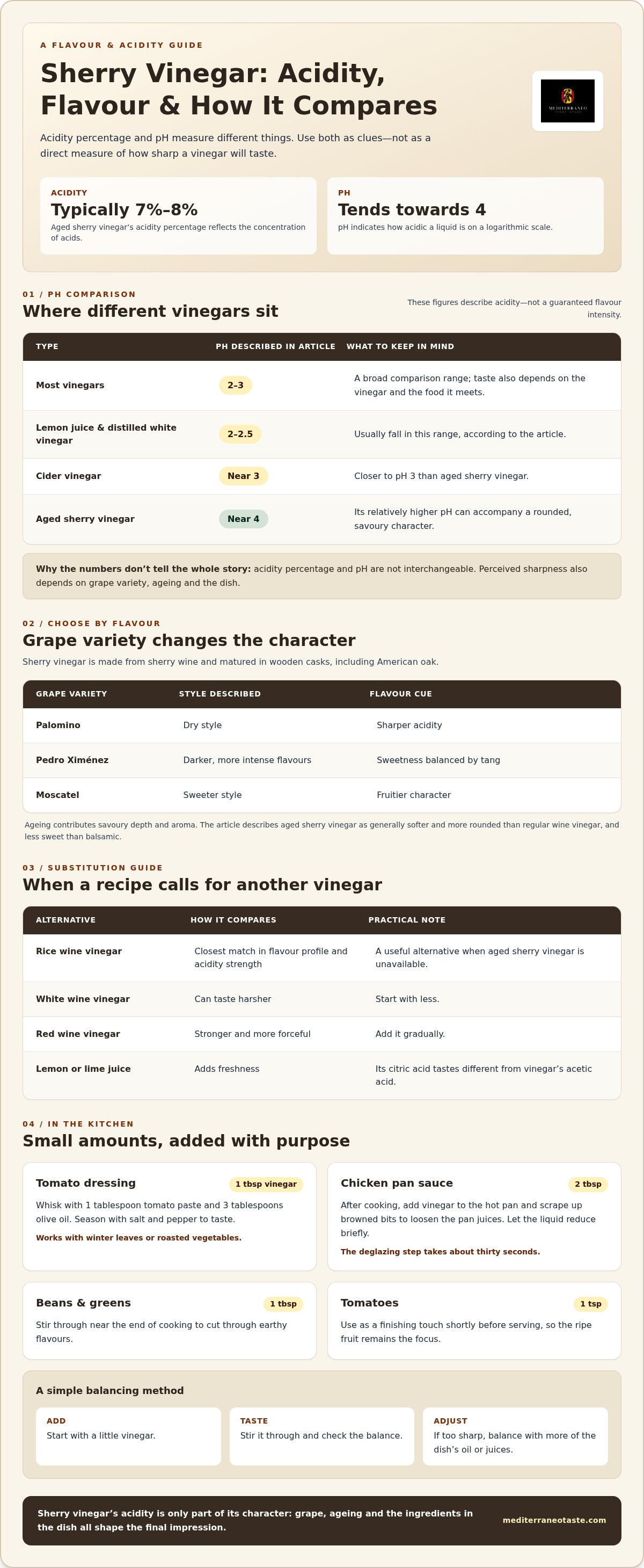
Sherry vinegar brings a bright tang, but acidity percentage and pH describe different things. Its acidity typically sits between 7% and 8%, while its pH tends towards 4. These measures aren't interchangeable: acidity percentage reflects the concentration of acids, while pH indicates how acidic a liquid is on a logarithmic scale. That distinction helps explain why a vinegar can have substantial acidity yet taste rounded.
For a simple comparison, most vinegars have a pH between 2 and 3. Lemon juice and distilled white vinegar usually fall between 2 and 2.5 pH. Cider vinegar is closer to 3 pH, while aged sherry vinegar tends towards 4 pH. These figures describe acidity, not a guaranteed flavour intensity. Taste also depends on the vinegar’s grape, ageing and the food it meets.
Sherry vinegar generally has a lower acid level than red or white wine vinegar. Its flavour is often softer and more rounded than regular wine vinegar, and less sweet than balsamic. Palomino grapes make a dry style with sharper acidity. Pedro Ximénez tends to bring darker, more intense flavours, with sweetness balanced by tang. Moscatel produces a sweeter, fruitier style. The grape variety can change how sharp the vinegar tastes, though it does not change how pH works.
Ageing adds another layer. Sherry vinegar matures in wooden casks, including American oak, where its character develops over time. The barrel influence contributes savoury depth and aroma, but there is no simple conversion between pH and perceived sharpness. In a tomato dressing, for example, a rounded vinegar can lift the fruit without tasting as forceful as a sharper wine vinegar.
Are there substitutes for aged sherry vinegar in recipes? Rice wine vinegar is the closest match in flavour profile and acidity strength. White wine vinegar can taste harsher, so start with less; red wine vinegar is stronger and more forceful, so add it gradually. Lemon or lime juice adds freshness, but its citric acid tastes different from vinegar’s acetic acid.
How should aged sherry vinegar be stored and how long does it last? Keep the bottle in a dry cupboard away from direct heat. Sherry vinegar can keep almost indefinitely and may continue to mature in storage.
Are there any health, acidity, or dietary concerns with cooking with sherry vinegar? Its tang can dominate a dish if you pour freely, so add a little, taste, then adjust. Sherry vinegar has no alcohol left after fermentation and bottling, though its acidity remains part of its flavour.
Quick recipes using sherry vinegar
A simple dressing gives aged sherry vinegar room to shine. Whisk together 1 tablespoon tomato paste, 1 tablespoon vinegar and 3 tablespoons olive oil. Season with salt and pepper to taste. The tomato paste adds savoury body, while the oil softens the dressing’s tang. Toss it through winter leaves or spoon it over roasted vegetables. Add the vinegar gradually if you prefer a gentler finish, then taste before adjusting the seasoning.
For a warm pan sauce, use vinegar to lift the browned flavour left after cooking. Once the food is removed, add sherry vinegar to the hot pan and scrape up the browned bits. The deglazing step takes about thirty seconds. For a quick chicken skillet, use 2 tablespoons to loosen the pan juices, then let the liquid reduce briefly. Pour the sauce over the chicken so its sharp, savoury notes balance the richer juices.
Small amounts can transform quick vegetable sides. Stir 1 tablespoon sherry vinegar through beans and greens near the end of cooking. The vinegar cuts through their earthy flavour without needing a long-simmered sauce. For tomatoes, use 1 teaspoon as a finishing touch. That smaller measure brings brightness without overwhelming ripe fruit. Taste the vegetables first, then add the vinegar and mix thoroughly so each bite receives an even seasoning.
Treat these quantities as starting points, not fixed ratios for every dish. A dressing needs enough oil to carry the vinegar across the leaves, while a pan sauce concentrates as it reduces. In beans, greens or tomatoes, the food’s moisture and natural sweetness affect the balance. Add a little, stir, then taste. If the result feels flat, adjust the seasoning; if it tastes too sharp, balance it with more of the dish’s oil or juices.
Sherry vinegar also works in sauces, reductions and pickling. In a reduction, its flavour concentrates as liquid evaporates, so begin with a modest splash and taste as it cooks. For a quick pickle, mix it with the recipe’s other ingredients, then let the vegetables absorb the tang. A savoury spritz can include half an ounce of sherry vinegar, offering a bolder way to explore its acidity beyond the pan.
When should aged sherry vinegar be added during cooking? Add it at the end for a bright finishing note, or use it to deglaze a hot pan after cooking. In a sauce or reduction, add it earlier so it can mingle with the other flavours; taste as it concentrates.
Serving sherry vinegar with vegetables, salads and lamb’s kidneys
A final splash can sharpen familiar Spanish dishes without masking their main ingredients. Try sherry vinegar over gazpacho, where its tang complements ripe tomato and cool cucumber. For fresh tomatoes, add it shortly before serving so the fruit remains the focus. Its rounded, savoury character contrasts with sweet, juicy produce, while olive oil carries it across each spoonful.
In salads, sherry vinegar can bring ingredients with different textures together. A white bean salad, for example, pairs creamy beans with crisp vegetables and a vinegar dressing. Stir the vinegar into olive oil first, then season and toss it through the salad just before serving. This coats the ingredients evenly and helps keep the beans intact. Add leafy greens at the last moment, as dressing them too early can soften their texture.
Cooked asparagus and artichokes also benefit from a little acidity. Drizzle sherry vinegar over warm asparagus after cooking, allowing the residual heat to release its aroma. With artichokes, add it after cooking and combine it with olive oil to complement their earthy taste. Both vegetables have distinct flavours, so start with a light touch. Taste a piece before adding more to the serving plate.
Lamb’s kidneys offer a rich, savoury pairing. Their concentrated flavour can stand up to sherry vinegar’s tang, especially when the vinegar is added at the end of cooking. Finish the kidneys with a little vinegar, then taste before adding more seasoning. The acidity helps balance the dish without requiring a heavy sauce. Serve promptly, while the kidneys are warm and their surface still carries the pan’s savoury juices.
A practical starting point is one teaspoon per serving, added at the end of cooking. Try this for a warm vegetable side or a plated portion of lamb’s kidneys, then adjust to suit the ingredients. For a shared bowl of white bean salad, whisk the vinegar into the dressing rather than pouring it directly over one spot. This distributes the flavour and makes it easier to judge the balance across the dish.
Match the vinegar’s intensity to the food. Gazpacho and fresh tomatoes benefit from a restrained finish, while earthy artichokes and lamb’s kidneys can take a more pronounced savoury note. In each case, taste the dish first, add the vinegar, then taste again before serving. This simple sequence keeps the acidity in balance with the olive oil, vegetables and main ingredient.
Sherry vinegar types and ageing periods
A sherry vinegar label can tell you about its maturation and grape character. Standard Sherry Vinegar is aged in wooden casks for six months to two years. Reserva indicates at least two years of ageing, while Gran Reserva indicates at least ten years. These terms distinguish a younger, livelier vinegar from one with a more developed character. Longer ageing can bring greater depth and complexity.
Ageing takes place in wooden casks using the criaderas y solera system. In this method, vinegars of different ages are blended as portions move through the cask stages. The blend develops over time, rather than each bottle representing vinegar from a single harvest. Some sherry vinegars can mature for ten to twenty years in this system. The age category on the label indicates minimum maturation, not the exact age of every drop.
Grape varieties also shape the style. Palomino produces dry vinegar with a sharper edge. Pedro Ximénez brings darker, more intense flavours, with sweetness balanced by acidity. Moscatel tends towards a sweeter, fruitier profile. For a savoury dressing, Palomino offers a brisker accent; Pedro Ximénez may suit a dish that welcomes richer, rounder notes. The grape name helps you anticipate the flavour before opening the bottle.
The sherry wine used as the base creates further distinctions. Vinegar made from fino is light and dry. Amontillado produces a nuttier, medium-bodied style, while oloroso gives a darker, more intense result. These descriptions can guide pairings: try fino in a delicate dressing, amontillado with beans, or oloroso alongside robust cooked ingredients. Choose according to whether the dish needs brightness, nutty depth or a fuller finish.
What should you look for on a Spanish sherry vinegar label, including PDO certification? Look for the Protected Designation of Origin (D.O.P.) emblem, which identifies authentic sherry vinegar, and check the ageing term and grape variety. Reserva and Gran Reserva indicate their respective minimum ageing periods, while Palomino, Pedro Ximénez and Moscatel signal distinct flavour profiles.
Use the label as a practical selection guide. Choose a younger standard vinegar for a direct, lively note in everyday cooking. Select Reserva for a more developed character, or Gran Reserva when a dish benefits from pronounced barrel-aged complexity. A subtle dressing, for example, may call for a lighter style, while a robust sauce can welcome the depth of longer maturation. The grape and wine style can then refine your choice.
How much aged sherry vinegar should you use in cooking?
Start with the dish’s purpose, not a fixed pour. A few drops can sharpen a sauce, while a dressing needs enough vinegar to balance its oil. A concentrated reduction changes as liquid evaporates, so its flavour can intensify during cooking. When using aged sherry vinegar for cooking, add a little, stir well, then taste before adding more. This measured approach keeps the vinegar balanced with the other ingredients.
For a flat sauce, start with half a teaspoon of sherry vinegar and a pinch of salt. Stir both in, then taste again. The vinegar adds brightness, while the salt can bring the sauce’s flavours into focus. If the sauce already contains citrus, wine or another acidic ingredient, use less vinegar at first. Each sour element contributes to the overall impression.
Consider the main ingredient, too. A mild vegetable purée can be overwhelmed by a generous pour, while a rich sauce may benefit from a livelier finish. In a pan sauce, account for any vinegar added during deglazing before adjusting the seasoning. For a dressing, mix the vinegar with oil, then taste it on a leaf or vegetable. Sampling it this way gives a better sense of the final balance than tasting the dressing alone.
- For a delicate sauce: begin with a small splash and add more only after stirring.
- For a reduction: taste as it cooks, since evaporation concentrates the flavour.
- For a dressing: test it on the salad ingredient, not just from the spoon.
- For a finished dish: add vinegar at the end when you want its fresh tang to stand out.
Sweetness and richness affect how much acidity a dish can carry. A sauce with tomato paste, for example, has savoury body that can balance the vinegar’s tang. In a lighter preparation, the same amount may taste more prominent. Grape variety matters, too: a dry Palomino vinegar can feel sharper than fruitier Moscatel. Let the dish and vinegar guide your adjustments rather than relying on the bottle alone.
Keep a simple tasting sequence: season the dish, add vinegar sparingly, stir, then taste again. If the sauce seems flat, add a little more. If acidity dominates, bring the other ingredients back into balance instead of pouring in more vinegar. For Spanish cooking inspiration beyond sauces, explore Spanish cooking ideas as you plan your next meal.
The author suggests that delis or providores stocking expensive olive oils and balsamic should also have a good sherry vinegar. If you’re choosing a bottle for regular cooking, treat it as an ingredient worth tasting before use. A bottle that suits your palate can be added cautiously to sauces and dressings, with the amount guided by the dish rather than a rigid measure. This keeps the focus on balance, whether you’re seasoning a sauce or mixing a dressing.
Mediterraneo Taste Spain: Mediterranean Delicacies
Mediterraneo Taste Spain offers Mediterranean delicacies and Spanish cooking ingredients for home cooks exploring flavours from the region. If sherry vinegar has inspired you to create a broader Spanish meal, paella is another way to bring lively, layered flavours to the table. A suitable paella pan helps you prepare the rice dish with the right equipment, while a paella kit can bring key cooking essentials together.
Explore Mediterraneo Taste Spain’s range when you’re ready to discover ingredients and tools for Spanish cooking. Choose what suits the meal you have in mind.
Visit Mediterraneo Taste Spain.
Make your next Spanish meal your own
Let aged sherry vinegar for cooking inspire a fresh idea for your next meal. Choose a dish you enjoy and make one thoughtful change: introduce a new ingredient, adjust the seasoning, or set the table for a relaxed Spanish-style gathering. Small choices can turn familiar cooking into an occasion worth savouring.
Mediterraneo Taste Spain offers Mediterranean delicacies and paella, as well as paella pans for preparing rice dishes at home. Explore these options as you shape a menu around the flavours and traditions you want to enjoy. Whether you’re planning a quiet dinner or sharing food with friends, let curiosity guide your next dish.
Contact Mediterraneo Taste Spain to explore its Spanish food and cooking range. Take the next step towards a meal that feels distinctly yours, and enjoy the pleasure of discovering something new at your table.
Frequently Asked Questions
What is sherry vinegar?
Sherry vinegar is a Spanish vinegar made from sherry wines associated with Jerez de la Frontera. Its grape varieties include Palomino, Pedro Ximénez and Moscatel, each with a distinct flavour character. Use it to season and lift savoury foods, not simply to add sourness. A few drops can brighten lentils or roasted peppers while adding a rounded, wine-derived note.
What is aged sherry vinegar and how is it made?
Aged sherry vinegar matures in wooden casks after its wine base turns to vinegar through fermentation. In the solera system, vinegars of different ages are blended as they move through cask stages. As a result, the finished vinegar develops a layered character rather than tasting like a single harvest. Try a drop alongside olive oil to notice its aroma before deciding how it might suit a dish.
What are the different aging categories of sherry vinegar in Spain?
Spanish sherry vinegar categories include standard, Reserva and Gran Reserva. Standard vinegar is aged from six months to two years; Reserva requires at least two years, and Gran Reserva at least ten years. These labels indicate minimum ageing, not the precise age of every part of a blended vinegar. When comparing bottles, consider the category alongside the grape variety, as both influence the style you bring to your cooking.
How does aged sherry vinegar taste compared with regular sherry vinegar and balsamic vinegar?
Aged sherry vinegar tends to taste more rounded and developed than a younger, more direct style, with maturation sometimes contributing savoury, nutty notes. It is generally less sweet than balsamic vinegar, which often has a more pronounced sweetness. The difference matters in a dish: choose sherry vinegar to accent savoury ingredients, or balsamic when a sweeter finish better suits the other flavours.
What dishes and recipes are best for aged sherry vinegar?
Use aged sherry vinegar where savoury ingredients benefit from a bright, complex finish. It can enliven lentil dishes, roasted peppers, aubergine, warm potatoes or pan juices from cooked meat. For a quick dressing, mix it with olive oil and taste it alongside the salad ingredients before serving. Its character also suits sauces and reductions, where it can add depth rather than simply making the dish taste sour.