

The right paella setup suits your pan, cooking surface and occasion, not simply the largest kit. Choose a pan that fits your cooking space, a burner suited to its size, and practical utensils. For gas cooking, the burner should heat the entire pan evenly, according to the Boletín Oficial del Estado. An authentic Spanish paella equipment store should make it easier to bring these essentials together.
Choosing equipment means balancing your cooking surface, pan and heat source. This guide explains how to compare pan materials and formats, identify useful utensils, and choose between individual items and a set. You’ll also learn what to consider for home cooking and larger gatherings, so your equipment supports the way you want to prepare paella.
Key Takeaways
- Match the pan’s material and diameter to your cooking surface, serving needs and storage space.
- Choose utensils that make stirring, serving and handling the pan comfortable and practical.
- Pair a gas burner with the pan so heat can spread evenly across its base.
- Compare equipment sets with individual pieces to see which essentials suit your cooking setup.
- Plan your cooking surface and heat source before choosing equipment for home meals or gatherings.
Paella pans in different materials, sizes and formats
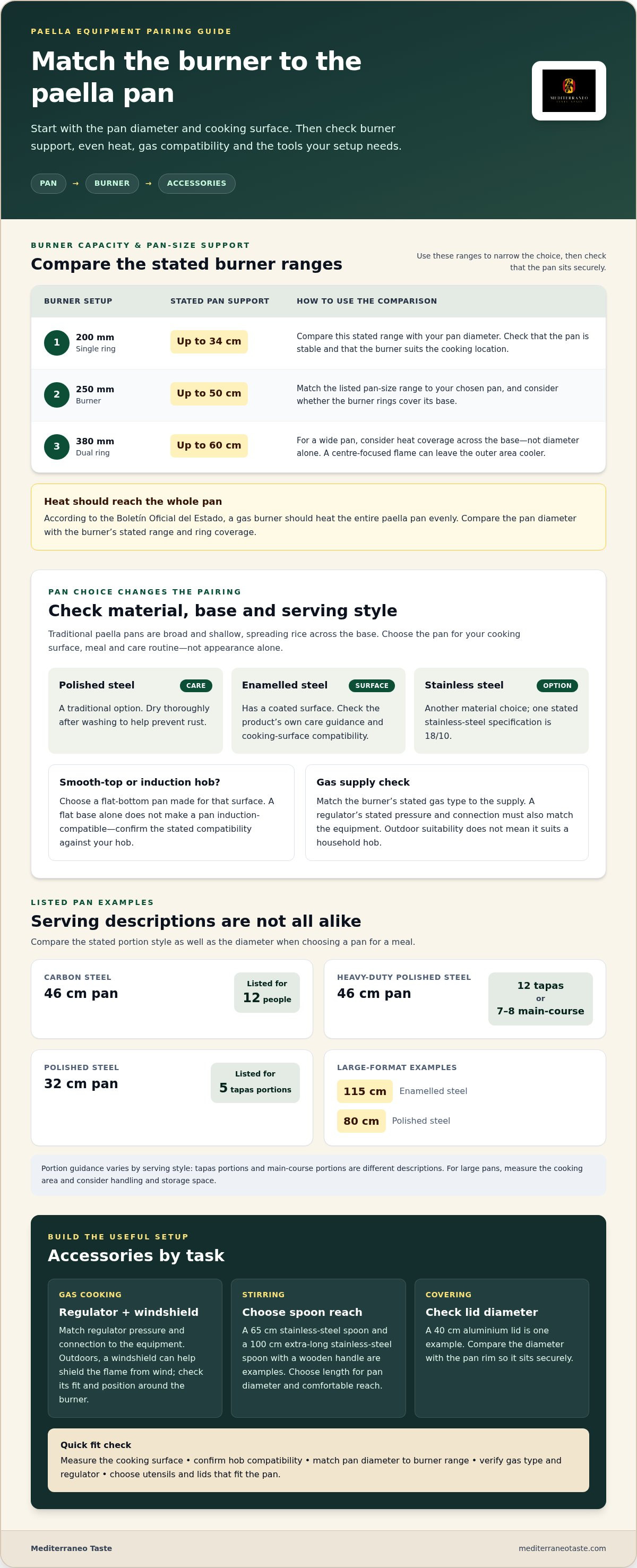
Start with your cooking surface, then choose a pan material and diameter to suit it. Traditional paella pans are broad and shallow, spreading rice across the base. For induction or a smooth-top stove, choose a flat-bottom pan made for that surface. A flat base alone doesn’t make a pan induction-compatible; it must be suitable for induction. Check the product’s stated compatibility against your hob before buying, rather than relying on appearance.
Material affects how you use and care for a pan. Polished steel is a traditional option, but it needs thorough drying after washing to help prevent rust. Enamelled steel has a coated surface, while stainless steel offers another material choice. One stainless-steel specification is 18/10. Compare the material, care guidance and cooking-surface compatibility instead of assuming every pan of the same material behaves identically. Spanish-made cookware offers an origin-led option, but practical suitability still matters.
Pan diameter should suit both your meal and cooking area. A 46 cm carbon-steel pan is presented as suitable for 12 people. A 46 cm heavy-duty polished-steel pan is listed for 12 tapas portions or 7-8 main-course portions. These serving descriptions differ, so consider how you’ll serve the rice. A 32 cm polished-steel pan is listed for 5 tapas portions. Use stated capacities as guidance, then consider the space your hob or burner provides.
Large formats need room for cooking, handling and storage. The largest listed enamelled pan has a diameter of 115 cm, while an 80 cm polished-steel pan is another large-format example. Before choosing a wide pan, measure the cooking area and consider where you’ll store it. The pan should sit securely over its heat source, and you’ll need enough access to stir and serve comfortably. For smaller cooking spaces, a more compact diameter may be easier to manage.
Narrow your choice by measuring the cooking surface, confirming induction compatibility if needed, and comparing the pan diameter with your meal style. Check whether serving guidance refers to tapas or main-course portions, as these are different ways of serving. Finally, review the care instructions for the pan material. This helps match the pan to your hob, cooking plans and cleaning routine, rather than choosing by appearance alone.
Mediterraneo Taste Spain offers Mediterranean delicacies, paella and paella equipment. When choosing a store, check its stated delivery destinations to see whether they include your location.
Paella utensils and accessories
Choose utensils and accessories for the tasks you need to do, from stirring rice to managing heat outdoors. Start by considering what your pan, burner and cooking area require when shopping at your authentic spanish paella equipment store.
Burners and Burner Accessories
Choose accessories that suit the burner setup and cooking location. A regulator connects the gas supply to the burner, so its stated pressure and connection must match the equipment. For outdoor cooking, a windshield can help shield the flame from wind. Check that its stands and position fit around your burner without obstructing access.
Pan Accessories
Pan accessories support serving, covering and handling. A paella spoon is long enough to reach across a broad pan, helping you stir ingredients without leaning over the centre. Examples include a 65 cm stainless-steel spoon and a 100 cm extra-long stainless-steel spoon with a wooden handle available through Mediterraneo Taste Spain. Choose length according to pan diameter and how much reach feels comfortable.
A lid can be useful when a recipe calls for covering the pan, while also helping protect cooked food between serving moments. A 40 cm aluminium paella lid is one example. Compare its diameter with the pan’s rim before choosing; a lid that sits securely is more practical than one that leaves large gaps. For a pan without a matching lid, plan how you’ll cover it using cookware you already own.
Keep serving and stirring tools separate for a smoother routine. A wide spoon can lift rice and ingredients from the shallow base, while a smaller utensil can help portion food at the table. Consider handle length, grip and material. Stainless steel is easy to wipe clean, while a wooden handle feels different in the hand.
Build an accessory set around the way you cook rather than collecting every item. For a gas setup, list the regulator and windshield needs first. For pan use, note whether you need a spoon, lid or both. Then compare dimensions: a 65 cm spoon suits a different reach from a 100 cm spoon, and a 40 cm lid only makes sense with a compatible pan. This quick inventory helps prevent mismatched extras.
Clean utensils and lids according to their materials. Dry metal accessories thoroughly before storing them, and avoid soaking wooden handles for long periods. Store long spoons where they won’t bend or press against other tools. Before your next cook, check that you have the burner accessories, pan lid, stirring spoon and serving spoon you need.
Paella burners for butane and propane
Choose a burner by matching its stated gas type and pan-size range to your equipment. Check the pan’s base against the cooking surface and the burner’s listed compatibility against its gas supply. A burner designed for outdoor use isn’t automatically suitable for a household hob.
Burner Capacity and Pan-Size Support
Burner diameter offers a practical starting point for pairing equipment. A 200 mm single-ring burner supports pans up to 34 cm; a 250 mm burner supports pans up to 50 cm. A 380 mm dual-ring burner supports pans up to 60 cm. These ranges help narrow the choice, but the pan must also sit securely over the burner.
Heat distribution matters as much as diameter. According to the Boletín Oficial del Estado, gas burners should heat the entire paella pan evenly. With a very wide pan, a burner that concentrates heat in the centre can leave the outer cooking area cooler. Compare the burner’s stated pan range with the pan diameter, then consider whether its rings cover the pan’s base.
Cooker and Open-Fire Suitability
Gas paella cookers are generally intended for outdoor setups, while household hobs have their own surface and pan requirements. For induction, the pan needs a compatible flat base; for other hobs, check the cookware’s stated suitability. An open fire requires a stable support that holds the pan level above the heat.
Match butane and propane burners to the gas supply and compatible regulator. Don’t assume a connector or regulator suits both fuels. Use the burner’s specified configuration, and arrange the cooking area so the flame isn’t obstructed by stands, wind protection or nearby objects.
Safety features also deserve attention. A 50 cm paella burner with a thermocouple safety system is one example of a model that includes a named safety feature. Read the manufacturer’s instructions for its use, assembly and gas connection. Keep the burner on a firm, level surface, and position the pan so it remains stable throughout cooking.
Before buying, compare three details: the fuel named for the burner, the pan diameters it supports, and the cooking location it’s designed for. For example, a 46 cm pan falls within the stated capacity of a 250 mm burner, but the full setup still depends on the burner’s fuel and placement instructions. That simple match helps avoid unsuitable combinations and supports even cooking across the pan.
Paella equipment sets and kits
A paella kit can simplify equipment selection by grouping items for a particular cooking method. First, distinguish ingredient kits from equipment sets. Ingredient kits combine seasoning, rice and olive oil; equipment sets bring together cooking hardware. Check the product description to see exactly what’s included before choosing.
At an authentic Spanish paella equipment store, compare sets by their purpose, not just their presentation. A set combining a pan, burner and accessories may suit someone putting together a cooking setup. If you already have a heat source, you may prefer a pan-focused option. Check the product details to see what each set includes and whether it suits your intended cooking arrangement.
Read the product description for information about what the set includes and its intended use. Serving needs depend on portion size and whether paella is the main dish, so plan around your menu and gathering rather than assuming a set description specifies capacity.
Use this checklist before choosing:
- Purpose: Decide whether you need ingredients, cooking hardware or both.
- Pan: Check its material, diameter and suitability for your cooking surface.
- Burner: Compare its stated fuel and supported pan range with your setup.
- Included items: Read the component list instead of assuming utensils or connections are included.
- Serving guidance: Relate the stated capacity to your meal and portion style.
Compare the set with equipment you already own. If you have a suitable pan, buying another as part of a complete set may mean duplicating something you don’t need. If you’re starting from scratch, a hardware set can reduce the work of matching separate components. Check the product details to distinguish cooking equipment from ingredients and understand the role of each set.
Consider where you’ll cook and store the equipment. An outdoor burner needs a suitable cooking area, while the pan’s diameter affects handling and storage. List the components you need, then compare each set with that list. Choose the combination that fits your setup instead of collecting extras you won’t use.
Listed prices provide another basis for comparison, alongside the components and cooking arrangement. These prices can help narrow the options, but they do not replace checking the item descriptions: a lower listed price alone does not establish which set best matches the equipment you need. Compare each set’s stated contents before deciding whether its price aligns with your plans.
Serving information can also help you assess a kit. Those stated capacities offer useful points of comparison when planning for a gathering, though the meal and portion style still matter. Match the serving guidance to your intended use, then check the set’s details and price together rather than relying on either one by itself. This makes it easier to compare options without assuming that similar serving descriptions indicate identical contents.
What equipment is needed to cook paella over gas or an open fire?
An outdoor paella setup needs a suitable pan, a stable heat source, compatible support and utensils. The right combination depends on whether you’re cooking over a gas burner or an open fire, and how the pan will sit above the heat.
For gas cooking, pair the burner with a pan it supports securely. According to the Boletín Oficial del Estado, gas burners should heat the entire paella pan evenly. This matters because rice spreads across a broad, shallow base. Consider how heat reaches the pan, then follow the burner and regulator instructions for assembly and use. Centre the pan according to the equipment guidance.
An open fire needs support suited to the pan and cooking arrangement. Choose a frame or cooking base that holds the pan level, then follow its manufacturer’s guidance for placement and use. The support should keep the pan stable while you stir. Check the fire-specific instructions, as equipment designed for gas may not be intended for an open fire.
Gather your cooking tools before you begin. A long-handled spoon helps you reach across the pan, while a lid may be useful when your recipe calls for covering it. Arrange ingredients, serving dishes and utensils around the cooking station so the sequence from preparation to serving stays clear. Use each accessory as intended and follow its care instructions after cooking.
- For gas: Match the burner, pan and regulator according to their product instructions.
- For an open fire: Use a support intended for the pan and cooking arrangement.
- For either method: Prepare a suitable spoon, ingredients and serving dishes before heating.
During cooking, observe how heat reaches the pan. If one area bubbles more strongly, consult the burner or fire equipment instructions for the appropriate adjustment method. Gas burners have their own controls, while open-fire setups depend on their fuel and support arrangement. Don’t assume instructions for one method apply to the other.
Before cooking, review the manual for each item: pan, support, burner, regulator and accessories. Confirm that their stated uses suit your setup, then arrange ingredients and utensils within reach. For an open fire, follow the instructions supplied for the fire support; for gas, follow the burner directions. This preparation lets you focus on the rice and cooking sequence while using each component as intended.
An apron can also be part of the equipment decision when ordering supplies: Orders over €100 qualify for a free apron. If you are comparing items for the cooking station, review the products and their stated uses together rather than choosing accessories in isolation. Consider which pieces you will handle during preparation, cooking and serving, and keep your selection suited to your planned method. Check the order details before completing a purchase, and make sure any chosen accessory is appropriate for the way you intend to cook. Treat the apron offer as an additional consideration, not a substitute for checking equipment guidance.
Mediterraneo Taste Spain: Mediterranean Delicacies
Mediterraneo Taste Spain brings together Mediterranean delicacies, paella and equipment for cooking at home. Once you’ve chosen a pan and setup suited to your cooking space, explore its paella pans and paella kits. A pan can suit cooks who already have a heat source, while an equipment set brings together cooking hardware. Pair your equipment with paella and Mediterranean ingredients for a meal inspired by Spanish flavours.
Visit Mediterraneo Taste online to explore the selection.
Make Your Next Paella Gathering Your Own
Choose equipment based on the way you like to cook and share food. Start with a pan suited to your space, then plan around the ingredients and flavours you enjoy. Mediterraneo Taste Spain offers Mediterranean delicacies, paella and paella pans for home cooking. If you’re looking for an authentic Spanish paella equipment store, explore the range and choose what fits your cooking plans.
Explore the range and choose what fits your table, cooking style and next occasion. Whether you’re preparing a familiar favourite or planning a meal with friends, Spanish food offers a generous invitation to gather, cook and enjoy. Take the next step at Mediterraneo Taste Spain, and bring a little Mediterranean inspiration to your kitchen.
Frequently Asked Questions
Which paella pan materials are authentic, and how do they compare?
Polished steel, enamelled steel and stainless steel are all used for paella pans, with different care needs. Polished steel is a traditional choice, but dry it thoroughly after washing to help prevent rust. Enamelled steel has a coated surface, so handle it carefully to avoid damaging that finish. Stainless steel offers another option; 18/10 stainless steel is a specified grade. Choose based on cooking surface, care routine and preference.
Which Spanish brands make traditional paella pans and burners?
Garcima is a Spanish manufacturer of traditional paella equipment, including pans and gas burners. Its equipment range also includes sets that combine cooking hardware. If you’re comparing brands, look beyond the country of manufacture: compare the pan material, burner’s stated pan-size range and intended cooking setup. This helps you select a Spanish-made pan or burner that fits your own equipment and cooking plans.