

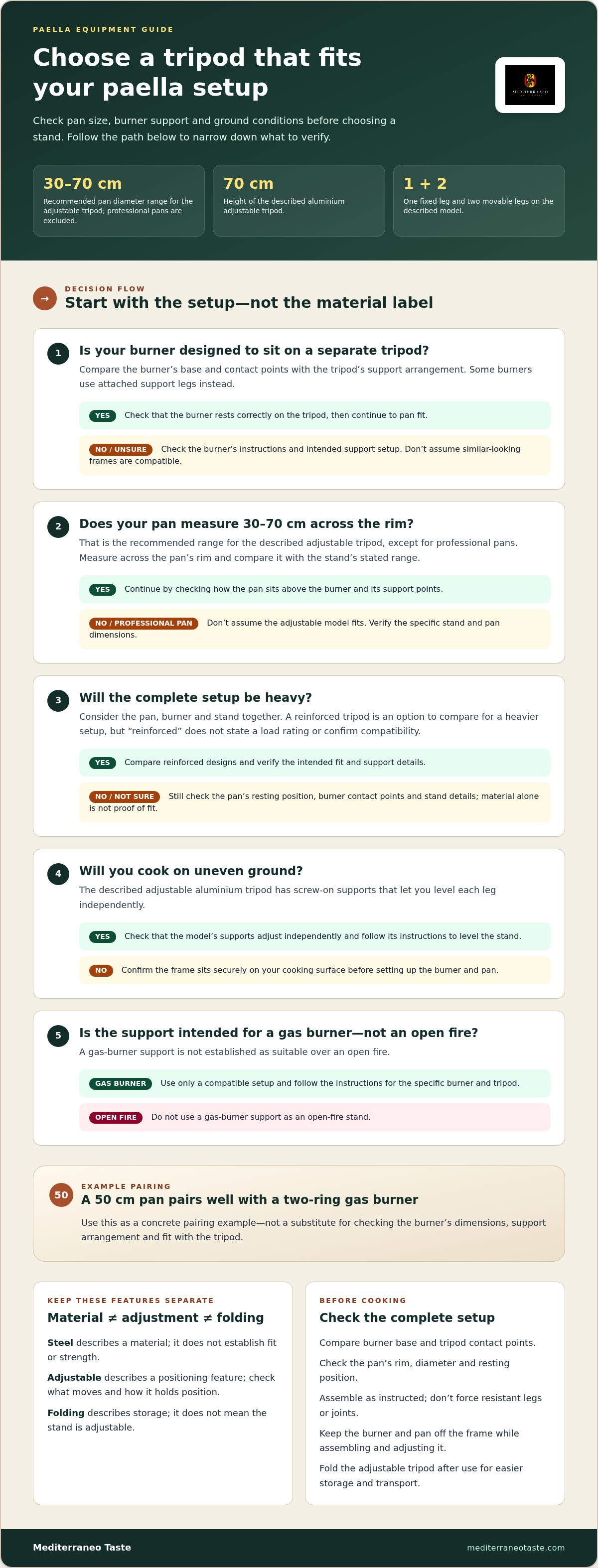
For a paella pan that needs a stable, adjustable base, choose a tripod that suits the pan and cooking setup. The adjustable paella pan tripod is aluminium, stands 70 cm tall and has one fixed leg and two movable legs. Screw-on supports let you level each leg independently, helping the stand sit securely on uneven ground.
Choosing a paella pan tripod stand involves more than comparing materials. Consider your pan’s size and weight, the burner it will support and the surface where you plan to cook. For a heavier setup, compare reinforced designs with standard options, but don’t assume a label confirms load capacity or fit. This guide explains what to check when matching a stand to your pan and burner, and how to assemble, fold and store the frame. You’ll also learn what to consider when comparing adjustable models.
Key Takeaways
- Match the stand to your pan’s diameter and cooking setup; adjustable models are recommended for pans from 30 to 70 cm, except professional pans.
- Choose a reinforced stand when supporting a heavier pan, and consider the full setup rather than material alone.
- Use independently adjustable supports to level the stand on uneven ground before cooking.
- Fold the adjustable tripod after use to make storage and transport easier.
- Compare steel and forged steel options by how their construction suits your pan and the way you plan to cook.
Adjustable tripod stand for paella burners
An adjustable tripod supports a paella gas burner and gives the pan a raised cooking position. The described model is aluminium and stands 70 cm tall. Screw-on supports allow independent leg levelling. Its layout has one fixed leg and two movable legs, so the burner position can be considered alongside the pan’s fit.
Burner Support Legs and Reinforced Tripods
Burner support legs attach to the burner, while a tripod is a separate supporting frame. A reinforced tripod is another option to consider for a heavier setup. Compare the burner’s contact points with the stand’s leg arrangement. “Reinforced” describes a construction feature, but doesn’t provide a load rating or confirm compatibility.
Tripod Stands Versus Burner Legs
Both arrangements can support outdoor paella cooking, but they hold the burner differently. Burner legs are part of the burner setup; a tripod is a separate stand, and the adjustable model has adjustable supports. Compare the burner’s base with the stand’s support points, then check how the pan sits above them. Independent screw-on supports can help adjust each leg on uneven ground.
Burner Compatibility and Safety
The adjustable tripod is intended for use with a compatible paella gas burner. This doesn’t establish that it is suitable over an open fire, so don’t use a gas-burner support as an open-fire stand. Follow the instructions for the specific burner and tripod, as the approved setup and use depend on those products. Check the stated purpose and compatibility instead of assuming similar-looking frames work alike.
Pan size helps narrow the choice. The adjustable tripod is recommended for paella pans from 30 to 70 cm in diameter, except professional pans. Measure the pan across its rim, then compare that measurement with the stand’s stated range. A 50 cm paella pan pairs well with a two-ring gas burner, offering a concrete example of matching burner type to pan size.
Burner descriptions may use labels such as standard, premium and big-event, but those labels alone don’t show which burner suits your pan. Compare the burner’s dimensions and support arrangement with the pan and tripod. Check that the burner rests correctly on the stand and suits the intended cooking setup. For a heavy pan, consider a reinforced tripod as a separate support option.
The adjustable tripod legs are expertly crafted to meet high European standards for outdoor cooking equipment. The tripod has one fixed leg and two movable legs, unlike separate burner-leg sets. Before choosing, check whether your burner is designed to sit on a tripod or use attached legs.
Adjustable steel tripods
“Steel” describes a material; “adjustable” describes a feature of the frame. A steel tripod isn’t necessarily adjustable, and the material alone doesn’t show how it fits a particular burner or pan. Assess each claim separately. Look for a visible adjustment mechanism and clear information about the equipment the stand is designed to support, rather than assuming similar product names mean similar construction.
First, identify what adjusts. A stand might have movable legs, threaded feet or another mechanism, and each design affects positioning and the type of ground it can accommodate. Check how the mechanism holds its position and whether you can reach it after placing the burner. Adjustments should help position the frame without leaving the burner loose or poorly supported.
Next, inspect the upper support. The burner should have a clear resting place, and the pan should sit securely rather than balance on an unstable edge. Compare the burner’s base with the tripod’s contact points, then consider the pan’s diameter and shape. A wide pan needs room for its rim while the burner remains beneath the cooking surface.
- Adjustment: Identify the mechanism and how it holds its position.
- Burner fit: Compare the burner base with the tripod’s support points.
- Pan fit: Consider the pan’s rim, diameter and resting position.
- Assembly: Check how the legs and frame connect before use.
- Storage: Establish whether the frame folds or remains assembled.
Don’t assume adjustable legs mean the frame folds. Folding describes how the stand packs away; adjustment describes how its position changes. A steel tripod may offer either feature, both or neither. This distinction matters if you plan to move the equipment between cooking locations or have limited storage space. Choose for the feature you need, not the material label.
Consider how you’ll use the support over time. A frame that stays in one cooking area may suit a simple, fixed arrangement. For a portable setup, consider how easily the design assembles and stores. Either way, inspect the joints and moving parts before placing cooking equipment on the stand. Clear instructions explain the intended assembly and use.
Compare the specific stand with your burner and pan as a complete setup. Product details should explain the material, adjustment method, assembly and fit. A description that only says “adjustable steel tripod” doesn’t establish dimensions or compatibility. Base your decision on the design details that affect your setup, not on “steel” as a guarantee of strength or universal fit.
Folding, assembly and storage
The adjustable tripod folds for storage and transport between outdoor cooking sessions. Choose a clear area to assemble it, with enough room to open the legs and check how each part fits. Keep the burner and pan separate while setting up, so their weight doesn’t obscure the joints or supports.
Follow the tripod’s assembly instructions. Designs differ, so don’t force a leg or joint if it resists. Open the frame as directed, then check that its parts are in their working positions. If the stand has moving supports, adjust them while the burner is off the frame. This makes the assembly process easier to follow and control.
- Choose a clear place for assembling the folded tripod.
- Open the frame according to its instructions.
- Check that the legs and joints sit in their intended positions.
- Position the burner only after the stand is assembled.
Once assembled, inspect the frame from several angles. Check that the legs are positioned evenly and the burner has a stable resting place. If anything looks misaligned, consult the assembly instructions before continuing. Don’t force a part into position, as a folding joint may require a particular movement or orientation.
After cooking, let the equipment cool before packing it away, following the burner’s instructions. Remove the pan and burner before folding the tripod. Fold the frame in the sequence specified for that model, without twisting or pressing parts together. A compact folded shape is easier to carry and store.
Store the folded stand where it won’t be bent or trapped beneath other equipment. Keep its parts with the burner setup so they’re easy to find next time. If you transport the tripod in a vehicle, position it so other items don’t press against its legs or joints. This helps preserve the frame’s shape between cooking sessions.
Before using the tripod again, reopen it and inspect its joints, legs and supports. Compare the assembled frame with the instructions, especially after transport or storage. Check that the parts move as intended and that the burner sits correctly. Careful packing and a brief inspection help make setup straightforward.
Forged steel tripods
A forged steel tripod is a distinct construction option for supporting paella equipment. “Forged” describes how the steel is shaped, but doesn’t tell you the tripod’s dimensions, weight capacity or adjustment range. Check those details separately. Before choosing a model, compare its leg layout and burner contact points with the pan and burner you intend to use.
Assess the structure rather than relying on the material name. Check where the legs meet the frame, how the burner rests and whether the feet sit securely on your cooking surface. The stand should hold the burner centrally so the pan is supported evenly above it. If a product description names forged steel without explaining the construction, the material alone can’t answer questions about fit.
Use this practical comparison sequence when assessing a forged steel design:
- Leg arrangement: Check whether the legs spread far enough to create a stable base for your burner.
- Burner seat: Inspect how the burner rests and whether it can sit centred without rocking.
- Pan clearance: Consider the pan’s diameter and how its rim will sit over the burner.
- Adjustability: Look for a clear mechanism if you need to level individual legs.
- Storage: Check whether the frame folds or remains rigid for transport and packing away.
Don’t assume forged steel means adjustable or foldable. Those are design features, not consequences of the material. For example, a fixed tripod may suit a dedicated cooking space, while a folding frame may better fit a setup that travels. Match the design to the way you cook, then check whether its burner supports suit your equipment. The adjustable tripod’s stated 30 to 70 cm recommendation applies to that model, not automatically to forged steel tripods.
Pan size still matters. A broad pan needs to rest securely, with the burner positioned beneath its cooking surface. Measure across the pan’s rim and compare that measurement with the stand’s stated fit range. If dimensions aren’t provided, don’t infer compatibility from the word “forged” or the stand’s appearance. Fit depends on the actual structure.
Before cooking with a forged steel paella pan tripod stand, assess the complete setup. Place the empty stand on the intended surface, position the burner, then check for movement and uneven contact. Add the pan only once the frame sits securely. This step-by-step check helps show whether the legs, burner seat and pan work together, without assuming all forged designs share the same specifications.
Reinforced stands for heavy pans
A heavy paella pan puts greater demands on its support. Consider the full cooking load: the pan, burner, ingredients and liquid all sit above the stand. A reinforced frame may suit this setup, but the word “reinforced” alone doesn’t establish a load limit. Check how the legs, joints and burner seat work together under the pan.
Assess the pan you’ll actually use, not just its empty weight. A large steel pan filled with rice, stock and ingredients weighs more during cooking than in storage, and the burner adds to the load. Choose a stand whose construction and fit suit the complete setup, and keep the pan centred over the burner. A tilted pan can shift its contents and put uneven pressure on the supports.
Inspect the frame before use. Check the joints where the legs meet the main support and confirm that the burner contact points sit evenly. Place the empty stand on firm ground, then position the burner and pan. Gently press around the rim to check for rocking before adding ingredients. If a leg moves, adjust the setup rather than trying to balance the pan by hand.
Diameter matters alongside weight. The adjustable tripod is recommended for non-professional paella pans from 30 to 70 cm, but that range doesn’t apply automatically to every reinforced design. A 50 cm pan, for example, should sit securely on its chosen support, with the burner positioned beneath the cooking surface. Match the pan’s rim width to the stand’s actual support layout.
For a heavy pan, assess these points together:
- Full setup: Account for the filled pan and burner, not just the empty pan.
- Leg placement: Confirm each foot rests firmly on the cooking surface.
- Frame condition: Look for loose joints, bent legs or uneven contact points.
- Pan position: Centre the pan so its weight is distributed across the support.
- Movement: Keep people and obstacles clear while positioning hot equipment.
A reinforced support is most useful when its structure suits the pan, burner and cooking surface as one system. It isn’t a substitute for stable ground or careful placement. For outdoor cooking, wind can also affect the flame and cooking area. A gas burner windshield with stands may help address wind exposure, while the tripod remains responsible for supporting the burner and pan.
Several reinforced-tripod configurations are listed at different prices, so compare the specific burner and support combination rather than treating all reinforced stands as interchangeable.
These listings identify specific products and prices, not a stated weight capacity. Check the particular model’s fit with your pan, burner position and cooking surface. Judge suitability for a heavy, filled pan by the stability of the complete setup, not its price or product wording.
Mediterraneo Taste Spain: Mediterranean Delicacies
Mediterraneo Taste Spain brings together Mediterranean Delicacies and paella essentials for cooks planning their next meal. Once you’ve chosen a stand, explore a paella pan or a paella kit to bring the cooking setup together. The right choice depends on the pan and burner you intend to use, alongside the ingredients you want to serve. Pair suitable equipment with the pleasure of Spanish paella, whether you’re preparing a meal at home or sharing it outdoors. Explore the available options, then choose what fits your cooking plans. Visit Mediterraneo Taste Spain to discover more.
Make your next paella gathering your own
Choosing the equipment is only part of planning a meal. Let your cooking space, the people around your table and the style of paella you want to make shape your setup. A paella pan tripod stand should suit the complete arrangement, leaving you free to focus on the rice, ingredients and shared meal.
As you plan your next cook, bring together equipment and Mediterranean flavours that suit the occasion. Mediterraneo Taste Spain offers Mediterranean Delicacies, Paella and paella pans for preparing Spanish-inspired meals at home. Explore the products and choose what fits your plans.
For a closer look at the range, visit Mediterraneo Taste Spain. Start planning a memorable paella meal, and enjoy making it your own.
Frequently Asked Questions
What is a paella pan tripod stand used for?
A paella pan tripod stand supports a compatible gas burner and pan for outdoor cooking. It can create a freestanding cooking setup when a kitchen hob or fixed barbecue isn’t suitable. For example, at a garden gathering, it can position the burner and pan in a dedicated cooking area. Match the stand to your burner and pan, and follow the equipment instructions.
How do you set up and level a paella pan tripod stand?
Assemble the empty stand on the surface where you’ll cook, then position its legs so the frame sits evenly. Adjust the supports individually if the model allows it. Place the burner centrally and check that it sits securely before adding the pan. On a sloping patio, choose the flattest available spot rather than relying on an unstable arrangement, and follow the stand and burner instructions.
Which is better for outdoor paella: a tripod stand or a paella burner with legs?
Both can support outdoor paella cooking. A tripod is a separate stand, and the adjustable model can be levelled on uneven ground; burner legs are part of the burner setup. Compare the burner’s support points with the fit of your pan.
What are paella pan tripod stand dimensions and weight capacities?
The adjustable tripod is 70 cm tall and recommended for pans 30-70 cm in diameter, except professional pans.
How much do paella pan tripod stands cost in Spain?
When shopping with specialists like Mediterraneo Taste Spain, prices for a quality paella pan tripod stand typically range from 25 to 60 euros depending on the height, material thickness, and whether the legs are adjustable for uneven outdoor surfaces.