

A seafood paella kit can include rice and seasoning yet leave the seafood, pan or burner for you to arrange separately. That is the detail to settle before ordering seafood paella kit delivery. “Kit” can mean an ingredient bundle or a set of cooking equipment, and neither label automatically means every part of the meal is included.
To make planning easier, compare the listed contents with your recipe and the equipment you already own. This guide explains how ingredient kits differ from equipment sets, what to look for in product details and which essentials may need to be sourced separately. It also covers practical planning for seafood, so you can follow its packaging and food-safety instructions when preparing your meal.
Key Takeaways
- “Seafood paella kit” can describe different bundles, so check the listed contents rather than relying on the label.
- Seafood paella is distinct from traditional Valencian paella, and seafood may need to be sourced separately.
- Compare rice, seasoning, oil, seafood and equipment with the meal you plan to cook.
- Plan seafood paella kit delivery around the products you are ordering and the safe handling of any fresh or frozen seafood.
- Ingredient kits and equipment sets serve different purposes. Choose the one that fills a gap in your cooking setup.
Seafood Paella Kit Delivery: What Are You Actually Ordering?
A “kit” can mean different combinations of food and equipment. Some bundles focus on pantry ingredients; others may include seafood or cooking hardware such as a pan and burner. When comparing seafood paella kit delivery options, look past the product name and identify what you will actually receive.
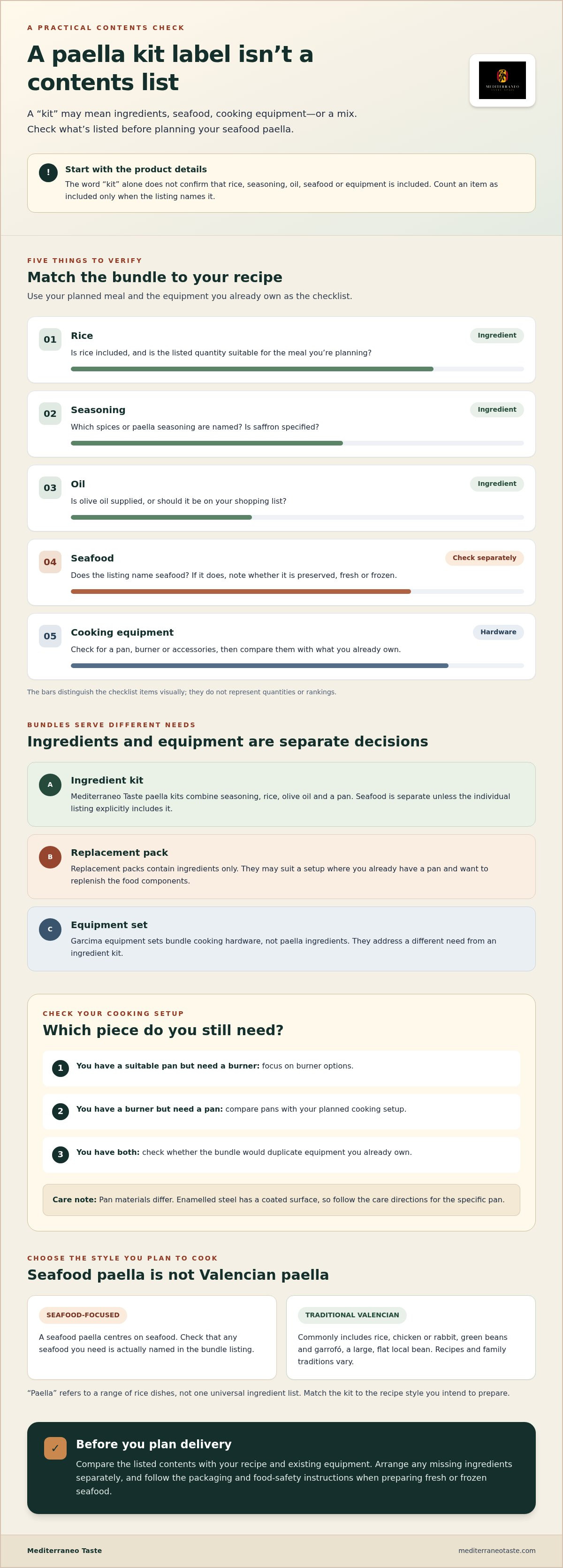
A seafood paella kit is a seller-defined bundle intended to help prepare seafood paella, with contents that vary by product. The term alone does not confirm that seafood, rice, seasoning, oil or equipment is included. Use the product details to check the inclusions.
Seafood paella and Valencian paella are not interchangeable
Seafood paella is a seafood-focused rice dish. Traditional Valencian paella is associated with a different combination of ingredients, commonly including rice, chicken or rabbit, green beans and garrofó, a large, flat local bean. Recipes and family traditions vary, so no single version represents every paella cooked in Spain. The Paella Wikipedia overview provides context on the dish’s regional variations.
Choose ingredients to suit the style you want to cook. A seafood recipe may centre on fish or shellfish, while a Valencian-style recipe calls for ingredients aligned with that tradition. “Paella” refers to a range of rice dishes, not one universal ingredient list.
Why the word kit can mean different things
Check the product inclusions rather than inferring contents from the title. A pantry-ingredient kit may supply rice, seasoning and oil, leaving seafood and equipment to you. A seafood bundle may include seafood, but only count it as included when the listing names it. An equipment set is different again: it brings together cooking hardware rather than recipe ingredients.
Mediterraneo Taste Spain’s Antonio Sotos paella kits combine seasoning, rice, olive oil and a pan. Seafood is separate unless the individual listing says otherwise. Replacement packs contain ingredients only. Garcima equipment sets bundle cooking hardware, so they are not a substitute for an ingredient kit.
Before comparing seafood paella kit delivery options, make a contents checklist:
- Ingredients: Is rice, seasoning or oil included?
- Seafood: Does the listing name it, and is it preserved, fresh or frozen?
- Equipment: Does the bundle include a pan, burner or other hardware?
Compare the answers with your recipe and the equipment you already own. This helps you avoid ordering on the assumption that the word “kit” means everything is included, and gives you a clear basis for comparing products.
What Does a Seafood Paella Kit Include? Check Ingredients and Equipment
Read the inclusions as a checklist, not as a promise based on the product name. Identify what the bundle supplies and what your seafood paella recipe still requires. Separating pantry ingredients, seafood and cooking hardware helps you avoid buying duplicates and spot any essentials to arrange separately.
Check these five categories:
- Rice: Is rice included, and is the quantity suitable for the meal you are planning?
- Seasoning: Which spices or paella seasoning are listed? Is saffron specified?
- Oil: Is olive oil supplied, or should it be part of your shopping list?
- Seafood: Count it as included only when the listing names it. Note whether it is preserved, fresh or frozen.
- Cooking equipment: Check for a pan, burner or accessories, then compare them with what you already own.
This contents check makes seafood paella kit delivery easier to plan around the actual order. It also shows whether you are buying ingredients, cooking hardware or both.
Ingredient kits, seafood bundles and replacement packs
Mediterraneo Taste’s Antonio Sotos paella kits combine seasoning, rice, olive oil and a pan. Seafood is separate unless the individual listing explicitly includes it. Replacement packs contain ingredients only, making them a practical option when you already have a pan and want to replenish the food components. Check the listing for exact inclusions, then account for any seafood and other recipe ingredients separately.
These distinctions make it easier to choose Spanish paella ingredients that fit your cooking plans. Explore the Mediterraneo Taste online shop and compare the product inclusions with your recipe before ordering.
When a pan-and-burner equipment set is a separate purchase
Garcima equipment sets bundle cooking hardware, not paella ingredients. They are designed for a different need from an ingredient kit: setting up or completing your cooking station. Take stock of your equipment first. If you have a suitable pan but need a burner, focus on the burner options. If you have a burner but need a pan, compare pans against your planned cooking setup.
Pan material also affects care. Enamelled steel has a coated surface, so follow the care directions for the specific pan rather than treating every material the same way. Accessories such as a spoon can support preparation and serving, but they do not replace the pan or burner. Keeping ingredients and equipment as separate decisions helps you order what you actually need.
How to Compare Seafood Paella Kits for Your Cooking Setup
Start with the meal you intend to cook, then compare each bundle with your recipe and cooking setup. A seafood paella kit may cover some ingredients, but that does not automatically make it a complete meal or a complete cooking set. The right kit is the one whose listed contents suit your recipe and setup.
Match kit contents to the meal and number of diners
Use your recipe’s ingredient list as the baseline. Check whether each product listing specifies seafood, rice, seasoning, oil and cookware. Then compare any serving guidance in the listing with the number of people you plan to feed. If no serving size is given, do not infer one from the kit’s name or appearance. Note what you will need to add, including seafood if it is not explicitly included.
| Compare | What to look for | What it means for your plan |
|---|---|---|
| Seafood inclusion | Seafood named in the product inclusions | If it is not listed, plan to source it separately. |
| Pantry ingredients | Rice, seasoning and oil identified individually | Match them against your recipe and pantry. |
| Pan | A pan specified as part of the bundle | Check whether it suits your intended cooking surface. |
| Burner | A burner included, or no burner listed | Decide whether your setup needs separate cooking hardware. |
| Cooking setting | Product details relevant to indoor or outdoor use | Choose equipment for the location where you plan to cook. |
This comparison keeps an ingredient kit distinct from a hardware set. One provides recipe components; the other provides cooking equipment. They meet different needs, so do not treat them as interchangeable.
Choose cookware and burner equipment for the cooking location
Consider where you plan to cook before selecting a pan or burner. For an indoor setup, check whether your cooking surface suits the pan. For outdoor cooking, assess the space and the equipment you already own. Gas burner compatibility, fittings and approvals can vary by model, so use the details for that specific product rather than making assumptions across burners.
If you need a dedicated burner, compare the relevant model details before choosing. You can also browse paella pans and gas burners to explore equipment options. When your recipe, kit contents and cooking location align, seafood paella kit delivery is easier to plan around the items you need.
Plan Seafood Paella Kit Delivery and Safe Preparation
Plan the ingredients and equipment before choosing a cooking date. Pantry items and perishable seafood have different storage needs, so do not assume they can be handled in the same way. Check the product details for the items you order, then follow the packaging and product directions when they arrive.
Choose an arrival date that suits the cooking plan
Pantry ingredients and perishable seafood call for different planning. Shelf-stable items may offer more flexibility, while fresh or frozen seafood needs to be handled according to its packaging and food-safety instructions. If seafood is part of an order, use the delivery and handling information provided for that product when planning your cooking date.
Consider when you can receive an order, particularly if it contains seafood. If the delivery information does not suit your planned cooking date, adjust your meal plan rather than relying on an unstated arrival time. For seafood paella kit delivery, plan around the details for the products you are ordering and arrange seafood separately when it is not listed as a kit inclusion.
Store ingredients and seafood according to their packaging
When your order arrives, check the labels and follow the stated storage requirements and use-by guidance. Store dry pantry ingredients as directed on their packaging. Handle fresh or frozen seafood separately, following its own packaging and food-safety instructions rather than applying the storage directions for rice or seasoning.
If you are unsure how seafood should be stored or used, follow the supplier’s instructions for that product. Do not rely on a universal storage time: requirements can vary depending on the product and its condition on arrival. Keep the information available until you are ready to prepare the meal.
Use this final checklist before cooking:
- Confirm the parcel: Compare its contents with the product listing and note any missing items.
- Read the labels: Check storage directions and use-by guidance for each ingredient.
- Prepare by category: Keep seafood handling separate from dry pantry storage and follow its specific instructions.
- Time the cook: Start preparation when you have the ingredients and equipment required by your recipe.
Choose the bundle first, then plan your cooking date around the product details and any seafood handling instructions. Explore Spanish paella ingredients and equipment to find options for your cook, and use the listed inclusions to guide your plan.
Choose Spanish Paella Ingredients and Equipment for Your Next Cook
A considered paella plan starts with ingredients that suit the dish and equipment that suits the way you intend to cook. Mediterraneo Taste offers Spanish ingredients and cooking equipment for home cooks, with the two categories kept distinct: ingredients contribute to the flavour of the rice, while cookware provides the tools to prepare it. For seafood paella, include seafood in your recipe plan and check the product listing before assuming it is part of a kit.
Select Spanish ingredients for seafood paella
Antonio Sotos is Mediterraneo Taste’s gourmet ingredient partner from La Mancha, where the family business was established in 1912. Its range includes Spanish saffron, paella seasoning, rice and olive oil. These ingredients can help build a pantry for Spanish-style rice dishes, but not every item is included in every kit. Check the product details to see what suits your recipe and what you will need to add.
Start with the flavour profile you want, then match the listed ingredients to your recipe. A seasoning or rice selection may provide a useful foundation, while seafood and other recipe components need to be accounted for separately unless the product listing says otherwise. This contents-first approach also makes seafood paella kit delivery easier to plan: you can see which items are included and which need separate planning.
Build the cooking setup around the right equipment
Garcima is Mediterraneo Taste’s equipment partner, with a family tradition from Valencia dating to 1920. Its equipment categories include paella pans, gas burners and cooking accessories. Choose according to your setup: decide whether you need a pan, a burner or an accessory, and consider where you intend to cook. Use the details for each equipment model rather than assuming burner approvals or compatibility.
Think through the cooking process, from setting up the pan to serving the rice. Choose a pan and heat source to suit your cooking location and recipe. Accessories can support the process, but they do not replace essential cookware. If you already have suitable equipment, focus on ingredients; if your setup needs attention, compare the relevant hardware separately.
Keep the final decision straightforward. Choose Spanish ingredients that fit the seafood rice dish you want to make, then select cookware and accessories that suit your cooking space and existing equipment. Check each product’s contents and details before ordering, especially when coordinating ingredients with seafood that is not included in the kit.
Explore Spanish paella ingredients and equipment to find options for your next cook and choose the combination that fits your planned meal.
Set the Scene for Your Next Paella
Good planning leaves you free to focus on the meal. Choose your recipe, check what its ingredients and equipment require, then make a list of what is already in your kitchen and what is missing. This helps you order with a clear understanding of what each kit contains.
Seafood paella kit delivery is one part of that preparation, not a guarantee that every part of the meal will arrive together. Check the kit contents, plan for any seafood that is not included and store each ingredient according to its packaging. With the practical details sorted, you can focus on preparing and sharing the meal.
Ready to plan your next cook? Explore Spanish paella ingredients and equipment and choose products that suit your recipe and cooking setup.
Frequently Asked Questions
How much paella rice should I allow per person?
Use the quantity in your chosen recipe or the serving guidance provided with the specific product. Rice portions can vary with the recipe, pan and how generously you plan to serve, so there is not one amount that suits every seafood paella. Check the pack’s rice quantity before ordering, then compare it with a tested recipe for your planned number of diners. If the figures differ, plan for the shortfall before cooking day.
Can I use frozen seafood in seafood paella?
Yes, frozen seafood can suit a home-cooked seafood paella if you follow its packaging instructions. Thaw it only as directed, and do not leave it to thaw at room temperature. Keep raw seafood separate from ready-to-eat foods and use clean utensils and surfaces. Add it at the point your recipe recommends, since cooking time varies by type and size. This helps protect both food safety and the seafood’s texture.
What is socarrat in paella?
Socarrat is the lightly toasted layer of rice that forms on the base of some paellas. It develops near the end of cooking as the rice absorbs the liquid, and is prized for its savoury, toasted character. Listen and smell as the rice finishes: aim for a toasted aroma, not a burnt one. The timing depends on your recipe, pan and heat source, so follow instructions suited to your setup.
What happens if I add seafood too early to paella?
Seafood added too early may cook for longer than it needs and become tough or overdone. The right timing depends on the ingredient, its size and your recipe, so do not add every type at once by default. Follow reliable recipe guidance and the seafood’s preparation instructions. For example, small pieces and larger shellfish may need different cooking times. Arrange additions so each cooks through while retaining its intended texture.
How should I store leftover seafood paella?
Transfer leftovers to a suitable container and refrigerate them promptly, following standard food-safety guidance. Keep the dish chilled, and reheat only the portion you plan to eat until it is thoroughly hot. Avoid repeatedly warming and cooling the whole batch. If you are unsure how long the paella has been out or whether it was stored safely, do not rely on smell or appearance alone; consult official food-safety advice.
Can I prepare a seafood paella kit in advance?
Yes, you can organise cookware and non-perishable ingredients ahead of time, provided you store each item according to its label. Keep seafood under the conditions stated on its packaging and prepare it close to cooking. When ordering through seafood paella kit delivery, plan around the details for the products you are ordering and the seafood’s handling instructions, rather than assuming every component has the same storage needs. Check your recipe before beginning.
Does seafood paella need to rest before serving?
A brief rest after cooking can let the rice settle before serving, but follow the timing in your recipe because the ideal pause depends on the cooking method. Avoid covering the pan if doing so would trap steam and soften the rice or socarrat. Use the resting time to bring serving dishes to the table, then serve the paella while it is warm and the rice still has its intended texture.