

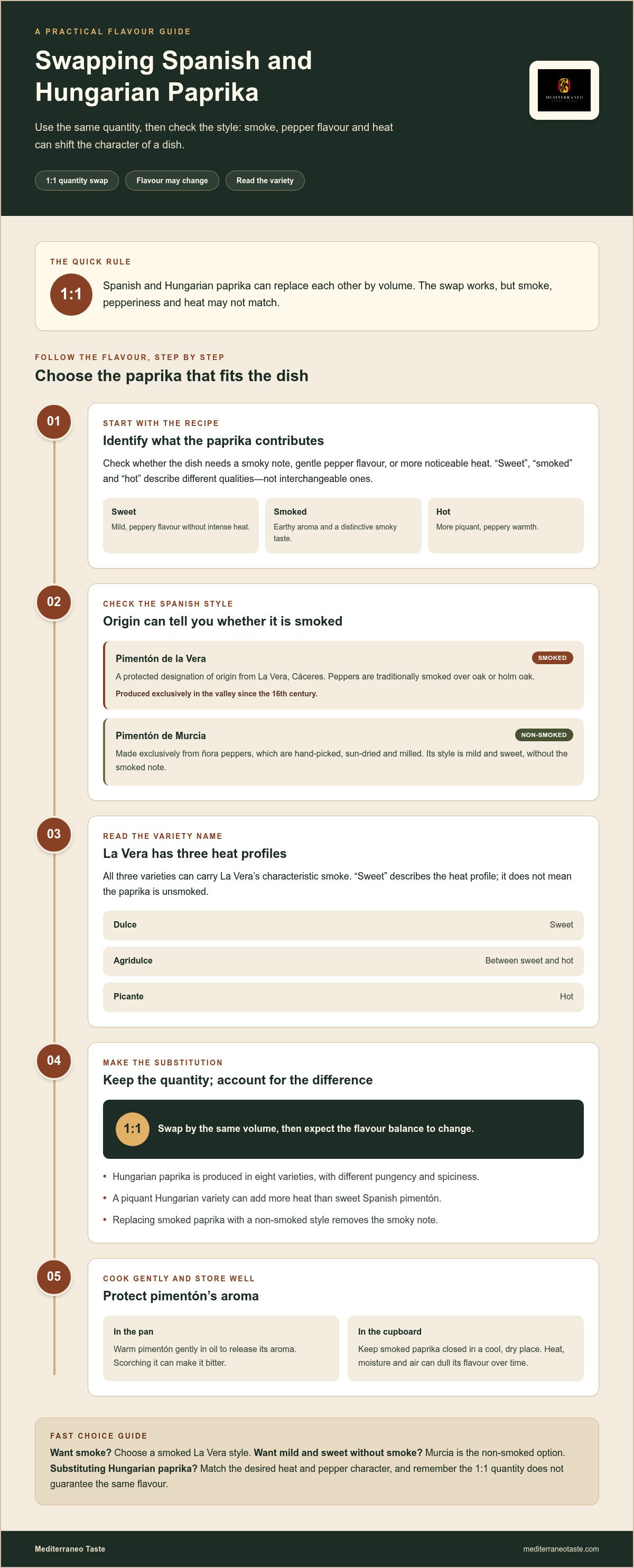
Yes, you can substitute Hungarian paprika for Spanish paprika at a 1:1 ratio, and the reverse works too. But sweet smoked Spanish paprika brings an earthy, smoky flavour, while Hungarian paprika ranges from sweet and peppery to hot. The swap works by volume, but it changes the character of the dish.
That difference matters when paprika does more than add colour. Spanish paprika in a sweet, smoked style can bring warmth and depth to stews, rice dishes and roasted vegetables. Hungarian paprika has a different balance of pepper flavour and heat. Choose the style that suits your dish, or substitute when you’re comfortable with the flavour changing.
Here, you’ll learn how Spanish and Hungarian paprika differ, when a direct swap makes sense and how sweet, medium and hot smoked varieties behave in cooking. You’ll also discover why paprika from La Vera tastes smoky, how Murcia’s version differs, and how to warm pimentón gently in oil without making it bitter.
Key Takeaways
- You can swap Spanish and Hungarian paprika at a 1:1 ratio, but expect the dish’s flavour and heat to change.
- Choose smoked paprika for earthy depth, and consider how its smoke will work with the other ingredients.
- Learn what sets La Vera’s smoked paprika apart from Murcia’s sun-dried style.
- Warm pimentón gently in oil to release its aroma; scorching it can make it bitter.
- Explore how sweet, medium and hot varieties bring different levels of warmth to a dish.
Can I substitute Hungarian paprika for Spanish paprika (and vice versa)?
Yes. Spanish and Hungarian paprika can be swapped at a 1:1 ratio, but the result will taste different. Spanish smoked paprika brings smoke, while Hungarian varieties can add a more piquant, peppery character.
Spanish Paprika and Pimentón
Spanish paprika, or pimentón, is ground pepper. Smoked pimentón is made from peppers that are smoked, dried and ground. The name identifies a style or origin, but it doesn’t tell you whether the paprika is sweet, hot or smoked. If a recipe calls for Spanish paprika, check the variety before substituting, especially if you want to retain the smoky flavour.
Protected Status and Producing Regions
Pimentón de la Vera is a protected designation of origin, or DOP, for paprika produced in La Vera, Cáceres. Its peppers are traditionally smoked over oak or holm oak, giving the powder its distinctive smoky quality. Pimentón de la Vera has been produced exclusively in the valley since the 16th century. This regional designation helps distinguish it from paprika made elsewhere in Spain.
Murcia also produces Spanish paprika, but its style is different. Pimentón de Murcia is made exclusively from ñora peppers, which are hand-picked, sun-dried and milled. The peppers are dried in the sun or warm-air driers rather than smoked. For smoked paprika, look to La Vera; Murcia’s paprika is a mild, sweet, non-smoked alternative.
Pimentón de la Vera Varieties
Pimentón de la Vera comes in three varieties: Dulce, Picante and Agridulce. Dulce is sweet, Picante is hot, and Agridulce sits between them. All three can have La Vera’s characteristic smoke, so “sweet” describes the heat profile, not an absence of smoky flavour. Check the variety name to match the paprika to your recipe.
For a direct substitution, use the same quantity, then account for the change in flavour. Hungarian paprika is produced in eight varieties, with different levels of pungency and spiciness. A piquant Hungarian variety can add more heat than sweet Spanish pimentón, while substituting non-smoked paprika for smoked pimentón removes the smoky note. For roasted potatoes, for example, choose according to whether you want smoke, peppery warmth or both.
Store smoked paprika in a cool, dry place to help preserve its quality and aroma. Keep the container closed between uses, and use the date on the packaging as your guide. How long it keeps its flavour depends on storage: heat, moisture and air can dull it over time.
Paprika is made from peppers, so anyone with a known pepper allergy should avoid it. The ingredient information here does not establish a specific medication interaction. Follow any food restrictions supplied with your medicine, and ask a pharmacist about a personal concern.
What is the difference between paprika and Spanish paprika?
Paprika is a broad name for ground pepper seasoning; Spanish paprika identifies a Spanish style or origin. The distinction matters because “paprika” alone doesn’t tell you the seasoning’s flavour or heat.
Spanish and Hungarian Paprika Differences
Spanish and Hungarian paprika reflect different regional traditions and flavour profiles, so the country name offers a useful first clue. Hungarian paprika is produced in eight varieties with differing pungency and spiciness. Spanish paprika, also called pimentón, may be smoky, depending on its style. Compare the label’s flavour and heat descriptions rather than relying on the word “paprika” alone.
Sweet, Smoked, and Hot Styles
Sweet, smoked and hot describe different qualities: flavour, smoky character and heat. Sweet paprika has a mild, peppery taste without intense heat, while smoked paprika adds an earthy aroma. Hot paprika brings a piquant, peppery flavour. These qualities aren’t interchangeable, so check which one your recipe calls for before choosing a seasoning.
Think of those descriptions as separate cues. “Sweet” describes the flavour and heat, while “smoked” describes a distinctive aroma and taste. Sweet smoked paprika combines both qualities. A sweet, non-smoked powder won’t add the same earthy character, even if its pepper flavour is similar.
Hungarian paprika’s eight varieties mean the country name alone is not a reliable guide to heat. One tin may be mild and sweet; another may be more pungent. Check the product description for terms such as sweet, mild or hot. Reading the label can help prevent a peppery seasoning from overwhelming a delicate sauce or vegetable dish.
For a recipe calling for gentle pepper flavour, sweet paprika brings warmth without intense heat. It suits dishes where you want colour and pepper character without a pronounced burn. Hot paprika, by contrast, makes the piquancy more noticeable. Start with the style specified in the recipe, then consider whether it also calls for smoke.
A recipe calling for smoked paprika needs an earthy note, not simply extra heat. Hot, non-smoked paprika shifts the balance in another direction. If the recipe asks for sweet paprika, choose a sweet style first, then decide whether smoke would suit the dish. Separating flavour, smoke and pungency makes the choice clearer.
In Spain, “Spanish paprika” and “pimentón” can refer to paprika associated with Spanish production, while “paprika” alone names the broader seasoning. Treat the country or regional name as context, then read the style description. This helps match the seasoning to the dish’s intended pepper flavour, smokiness and heat.
How Spanish paprika is used in cooking
Spanish paprika adds colour, pepper flavour or smoke, depending on the style. In Spanish cooking, ground pimentón can enrich a dish without adding fresh chilli heat. Choose a variety that suits the other ingredients, then heat it gently to keep its aroma present without letting smoky or peppery flavours dominate.
For a warm, rounded base, stir pimentón into oil over gentle heat. The oil carries its aroma through the other ingredients, making this useful in stews and vegetable dishes. Watch the pan closely: burnt paprika can taste bitter. Add it when the oil is warm, stir it through, and continue with the recipe before it darkens or scorches.
Roasted potatoes show how different paprika styles can change a familiar dish. Sweet paprika brings pepper flavour without intense heat; smoked paprika adds earthy depth. Using only hot paprika or only smoked paprika can overpower potatoes or paprikash, so combining styles may give a more balanced result. Adjust the blend to suit the dish rather than assuming one variety works equally well in every recipe.
Spanish paprika also works beyond Spanish dishes. A small pinch of hot or smoked paprika can add a savoury accent to Mornay sauce for macaroni cheese. Stir it in carefully so the spice disperses throughout the sauce instead of gathering in one bite. For a mild, creamy Mornay, begin with sweet paprika or use only a little of a stronger variety.
In Spanish-style cooking, pimentón can complement the savoury notes of vegetables, pulses and rice. Choose sweet paprika for pepper character without pronounced heat, or smoked paprika when its earthy aroma suits the other ingredients. A lentil stew, for example, can take a smoky note, while a delicate vegetable dish may need a lighter touch. Let the recipe’s main flavours guide your choice.
Think of paprika as a seasoning with several roles, not just a red powder for colour. Sweet, hot and smoked styles produce distinct results, and a blend can soften a strong note. Use gentle heat in oil-based dishes, taste as the flavours develop, and keep the quantity restrained when the recipe already includes assertive ingredients such as chilli or smoke.
La Vera paprika and its protected designation of origin
La Vera paprika connects a named Spanish region with a distinctive pepper-growing and smoking tradition. Its designation and history help explain what sets this paprika apart.
La Vera’s Protected Designation
Pimentón de la Vera has a protected designation of origin, or DOP, under European law. The designation ties the product’s name to its production area, La Vera in Cáceres province. For cooks, this geographical link distinguishes it from paprika made elsewhere, even when both powders look similarly vivid.
La Vera’s peppers are traditionally smoked over oak or holm oak. This process gives the paprika an earthy aroma and smoky flavour, rather than relying on added smoke flavouring. Its regional identity matters when a recipe calls specifically for the character of Pimentón de la Vera.
The valley’s production history reaches back to the 16th century. A DOP name therefore does more than identify a style: it signals a connection between place, pepper and established production practices. Look for the full regional name when you want paprika from La Vera.
Paprika’s Origins and Spread
Paprika begins with peppers, including Capsicum annuum, a species grown in central Mexico for more than 2,000 years. Spanish explorers brought peppers from the Americas to Spain during the 16th century. Their arrival introduced European cooks to a plant that could later be dried, ground and used as seasoning.
In 16th-century Europe, peppers were bred to reduce their heat. That change helped create milder pepper varieties suited to different culinary uses. Over time, drying and grinding turned peppers into a versatile powder, while local growing and processing traditions shaped distinct regional styles.
La Vera paprika reflects the connection between a plant and its growing region. Its production in the Cáceres valley links the wider history of peppers in Europe with a specific Spanish tradition. By comparison, Murcia’s pimentón is made from ñora peppers and dried without smoking, showing how regional methods create different flavours.
Knowing the origin helps you choose with purpose: select La Vera when you want its characteristic smoke and regional identity. For a non-smoked Spanish style, Murcia offers a different expression of paprika. The name on the tin can guide your choice before the powder reaches the pan.
Mild, medium, and hot smoked paprika varieties
Smoked paprika can be sweet, medium or hot, with each variety balancing pepper flavour and heat differently. In La Vera, the traditional names are Dulce, Agridulce and Picante. All are made from smoked peppers, so choosing a heat level also means deciding how assertively the smoky flavour should meet the rest of the dish.
Dulce means sweet, with a gentle pepper flavour and no intense heat. Choose it when you want La Vera’s smoky character without making a dish noticeably piquant. It suits recipes where paprika should support the main ingredients rather than compete with them. “Sweet” describes the paprika’s flavour and heat, not sugar added to the powder.
Agridulce is the middle style, between sweet and hot. Its name is often translated as bittersweet, but that doesn’t mean the powder tastes like dark chocolate or contains a bitter ingredient. Think of it as a more assertive pepper flavour than Dulce, with less heat than Picante. It offers a useful middle ground when a recipe needs warmth and smoke.
Picante means hot. It brings more piquancy, so the heat can become prominent in a dish. Use it when the recipe can welcome a peppery kick, rather than treating it as a direct flavour match for sweet paprika. Picante still has La Vera’s smoky character; heat and smoke are separate features that work together.
Read both the variety name and the word “smoked” on the label. Dulce, Agridulce and Picante describe the style, while smoking describes how the peppers were processed. This matters when substituting one tin for another: hot, smoked paprika changes both the heat and aroma compared with sweet, non-smoked powder.
For roasted potatoes, Dulce can add smoky depth without bringing the heat forward. Agridulce may suit a heartier dish that can carry more pepper character. Picante is the choice for a distinctly hot result. These are starting points, not fixed pairings; ingredients such as chilli, pepper and other strong seasonings affect how pronounced each variety tastes.
If a recipe calls for hot paprika but you want smoke without as much piquancy, choose a milder smoked variety and let other ingredients provide the heat. If it asks for sweet smoked paprika, don’t assume that any tin labelled “sweet” will taste smoky. Check the label for both qualities, then match the powder to the flavour balance you want.
Mediterraneo Taste Spain: Mediterranean Delicacies
Mediterraneo Taste Spain offers Mediterranean delicacies and paella products for readers inspired to bring Spanish flavours into their cooking. If you’re planning to make paella, a paella pan or paella kit can help you prepare it with suitable equipment. Explore these options when you’re ready to bring Spanish cuisine to your home cooking.
Choosing the right equipment is part of the experience: a pan designed for paella supports the dish’s broad, even cooking surface, while a kit brings together paella essentials. Explore paella pans and kits as you plan your next Spanish-inspired meal.
Visit Mediterraneo Taste Spain to explore its Mediterranean delicacies and paella products.
Make your next dish your own
Let the dish guide your next paprika choice. Consider the flavour you want at the table, then choose sweet, smoked Spanish paprika when its warmth and aroma suit the meal. A familiar recipe can be a useful starting point for exploring how a different seasoning changes its character.
Keep the next step simple: choose a dish you enjoy cooking, decide which flavour you want to bring forward, and make that the focus of your meal. Follow your curiosity and explore Spanish cooking one dish at a time.
Mediterraneo Taste Spain offers a place to continue exploring Spanish food and cooking. For a question or guidance on what to explore next, contact Mediterraneo Taste Spain. Bring your curiosity and enjoy discovering the flavours that inspire your next meal.
Frequently Asked Questions
Paprika Is Exciting, Right?
Yes, paprika can noticeably affect a dish’s aroma, colour and overall balance. Try a simple tasting: place a pinch of two paprika styles on separate pieces of plain bread with a little olive oil. Notice which aroma comes through first, then taste how each flavour lingers. This quick comparison helps you choose based on your preferences, not just a recipe label.
What is Spanish pimentón?
Pimentón is the Spanish culinary name for paprika. If a Spanish recipe uses the word, look closely at the style named beside it rather than assuming every tin will taste alike. A recipe that names a regional style gives you a more precise starting point. Matching that detail can help keep the seasoning’s character aligned with the dish.
What is Spanish sweet smoked paprika (pimentón dulce ahumado)?
Choose this style when you want rounded pepper flavour alongside a smoky note, without making heat the main event. Consider it for a dish where smoke should sit behind the other ingredients, not dominate them. If you’re adapting a recipe, account for the strong flavours already present. The best choice keeps the whole dish in balance.
How is Spanish smoked paprika traditionally made?
Traditional production turns harvested peppers into ground seasoning through drying and milling, while smoking shapes the aroma. When choosing a tin, check whether the label identifies a traditional smoked style or another type of paprika. Consider the finished dish: a recipe built around smoky aroma benefits from paprika with that characteristic flavour, not colour alone.
What are the main varieties of Spanish paprika: dulce, agridulce, and picante?
The names describe different flavour and heat profiles, so use them to fine-tune a recipe. Dulce suits a dish calling for milder seasoning; picante fits one that can carry more heat; agridulce offers an in-between option. When serving guests, choosing a milder variety means they can add other heat at the table, rather than making the paprika’s piquancy unavoidable.
What is the difference between Spanish smoked paprika and Hungarian paprika?
Choose between them by considering paprika’s role in the recipe. If the dish depends on a distinct smoky note, Hungarian paprika may not create the same effect. If the recipe needs pepper flavour or heat without relying on smoke, Hungarian paprika may suit it. The ingredient list and the flavour you want at the table are more useful guides than colour alone.
What does the Pimentón de la Vera PDO label guarantee?
The label identifies a protected product associated with La Vera, rather than paprika simply described as Spanish. That distinction helps when a recipe names the region or you specifically want its regional character. Treat the PDO as an origin cue, then use the variety name to choose a heat profile that fits your meal.
How can you use sweet smoked paprika in Spanish recipes?
Try it in a dish where a smoky accent can complement, rather than conceal, the other ingredients. For example, add a restrained amount to bean stew or use it to season roasted chickpeas. Taste before adding more, especially if the dish already includes strongly flavoured ingredients. This lets you judge the seasoning in context and keep its aroma in proportion.