

What if the clearest clue to a good turrón isn’t the picture on the packet, but the texture and ingredients described beside it? Buying authentic Spanish turron online means choosing without tasting first, and soft, hard and flavoured styles can look surprisingly alike on screen.
That uncertainty is understandable. A thoughtful choice depends on more than attractive packaging, especially when you’re selecting a sweet to share or give as a gift. Compare the style, ingredients and quantity, then consider how you plan to serve it. This guide explains what to look for and how to choose a type that suits your preferences or occasion.
We’ll explore how hard Alicante-style turrón differs from soft Jijona-style turrón, what ingredient and origin information can tell you, and how to assess flavoured variations. Mediterraneo Taste Spain brings together Spanish and Mediterranean food traditions, making turrón a delicious starting point for discovering the country’s much-loved sweets.
Key Takeaways
- Understand why turrón describes a family of Spanish sweets, not a single recipe or texture.
- Compare ingredient lists and product descriptions to make a more informed choice when buying authentic Spanish turron online.
- Use texture and flavour cues to narrow down soft, hard or flavoured styles for your preferences and serving occasion.
- Compare the stated quantity with your plans, then read the product’s storage directions.
- Serve turrón simply so its chosen texture and flavour take centre stage.
What Is Spanish Turrón? Understand the Sweet Before You Buy
Spanish turrón is a traditional sweet made in a range of recipes, textures and flavours. The name describes a category, not one fixed product: two items labelled turrón may differ in their ingredients, sweetness and texture. That matters when shopping online, where a photograph can’t show whether a sweet is crisp, yielding or smooth.
Many familiar traditional versions combine almonds with a sweetener such as honey or sugar. Other recipes vary the ingredients or add flavourings, so no single list describes every turrón. For a concise overview of the sweet’s background and varieties, see What is Spanish Turrón? When choosing a particular product, start with its own description and ingredient statement.
Turrón is a family of Spanish sweets made in varied recipes, rather than one sweet with a single required flavour, texture or ingredient list. Keep that in mind when looking for authentic Spanish turron online. It helps you distinguish the wider tradition from the specific product you’re considering.
What ingredients are commonly associated with turrón?
Almonds are a familiar feature of many traditional turrón recipes, often paired with honey or sugar. Ingredients differ between recipes and products, though. One version may highlight nuts, while another may use additional ingredients for a different flavour or consistency. Treat general descriptions as clues, not a substitute for the product details.
Read the ingredient statement to see what that particular turrón contains. If you’re choosing for someone with a dietary preference or sensitivity, don’t infer ingredients from the name or photograph. Use the product-specific information as your guide.
Why does turrón come in different forms?
Texture and flavour offer a useful first way to understand the category. Some descriptions point towards a firmer bite, while others suggest a softer or smoother sweet. Flavour cues can indicate whether almonds and sweetness take centre stage or share it with other ingredients. These descriptions help set expectations, but the recipe determines the final eating experience.
A product name can suggest a style, but it doesn’t tell the whole story. Look for details about texture, ingredients and flavour, then consider how you’d like to serve the sweet. A brief description may help you identify its general character; the ingredient statement gives a more exact picture of what’s in it.
As you browse, separate what the name suggests from what the product details say:
- Name: a useful clue to the type or style.
- Description: an indication of texture and flavour.
- Ingredient statement: the product-specific detail to read before choosing.
With those clues in view, you can compare the main styles and decide which suits your taste or occasion.
How to Assess Authentic Spanish Turrón Through Product Details
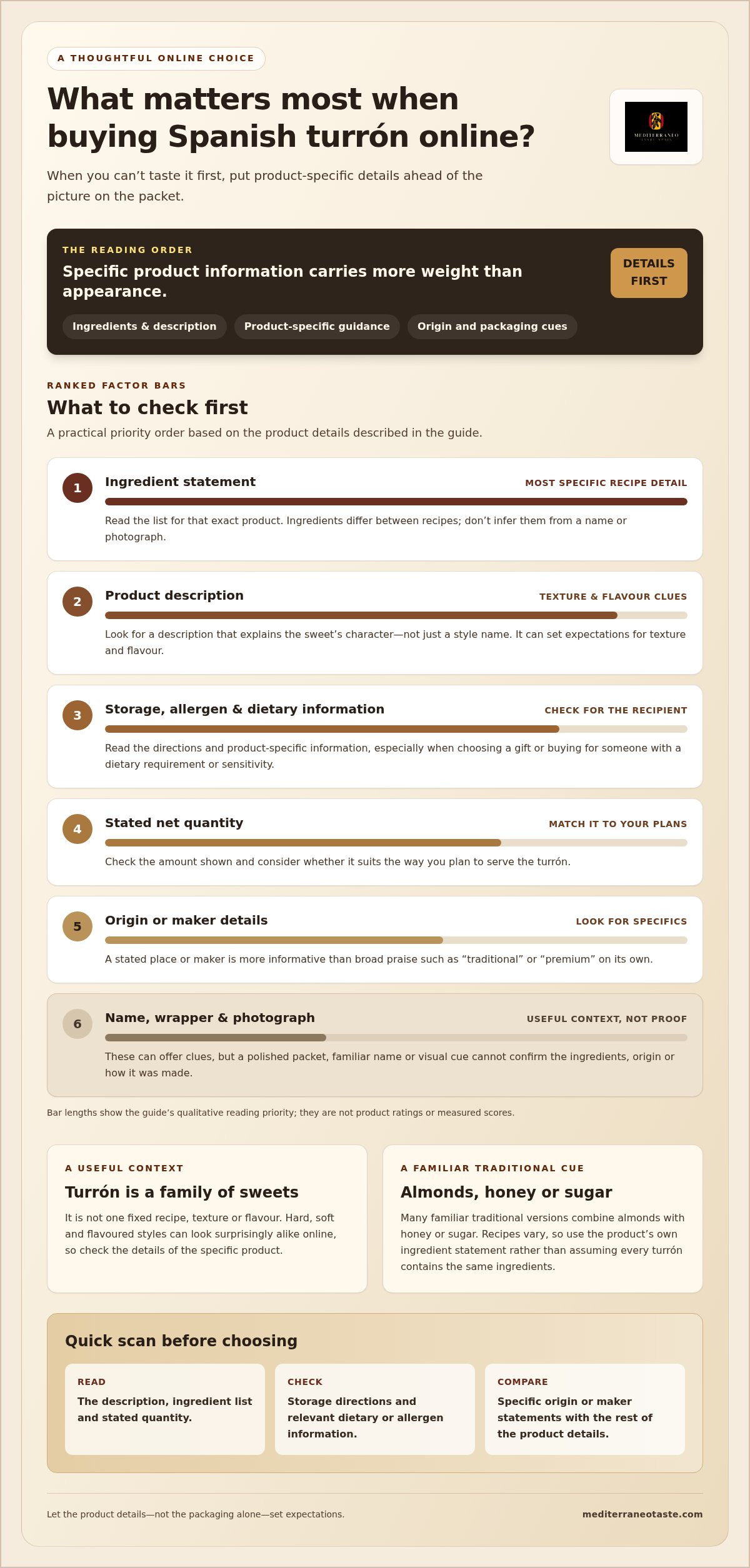
A polished wrapper can set the mood, but it can’t tell you everything about the sweet inside. When assessing authentic Spanish turron online, give more weight to written product details than to front-of-pack wording or a tempting photograph. Look for information about the specific item, not just turrón in general.
Which product details are most useful when shopping online?
Read the product description alongside the full ingredient list and stated net quantity. The description can set expectations for flavour and texture; the ingredients give a more precise account of the recipe; and the quantity helps you judge whether it suits your plans. A photograph adds context, but may not show the interior or provide the full ingredient information.
Before choosing, scan the listing or packaging for storage guidance and product-specific allergen and dietary information. This is especially important when buying a gift. Don’t assume a sweet is suitable based on its name, appearance or a general description. If a recipient has a dietary requirement, use the information for that exact product to guide your decision.
How should shoppers interpret origin and tradition claims?
Specific details are more useful than broad praise. A product page may state an origin or identify its maker; compare those concrete claims with the rest of the description. Words such as “traditional” or “premium” can suggest a positioning, but on their own they don’t explain the recipe, production place or ingredients.
Likewise, a single ingredient or visual cue can’t establish where a product comes from or how it was made. Almonds, a Spanish-sounding name or a photograph of a familiar style may offer context, but none tells the whole story. For a broader framework for reading origin and ingredient claims across Spanish foods, explore this guide to authentic Spanish ingredients.
Use this quick comparison as you browse:
- Description: Does it explain the product’s character rather than rely only on a style name?
- Ingredients: Can you see the product-specific list?
- Quantity: Is the stated amount clear and suitable for your intended serving?
- Storage and dietary details: Are the directions and relevant product information available?
- Origin: Is a specific place or maker stated, rather than implied by general wording?
When a detail matters to your choice, give more weight to a clear, product-specific statement than to attractive packaging or a broad claim. That makes online browsing more considered, whether you’re choosing for yourself or selecting a gift. To discover more Spanish food traditions, browse Spanish and Mediterranean delicacies.
Soft, Hard, or Flavoured Turrón? Compare the Main Styles
Texture is one of the most useful clues when choosing turrón online. A soft style suggests a yielding bite; a hard one points towards a firmer, more brittle experience. Flavoured versions offer another way to choose, adding a different taste direction rather than a ranking of quality or authenticity.
Use the comparison below as a starting point, not a promise about every recipe. Ingredients, preparation and product descriptions vary, so read the details for the individual item before deciding.
| Style | Expected texture | Flavour cues | A suitable serving moment |
|---|---|---|---|
| Soft | Generally yielding, smooth or dense | Often brings sweet, nutty notes together in a rounded bite | Offer small pieces after a meal or alongside coffee |
| Hard | Generally firm, with a crisp or brittle bite | May have a pronounced toasted-nut character | Serve in small portions as part of a shared sweet selection |
| Flavoured | Depends on the recipe and ingredients | May introduce chocolate, fruit or another stated flavour | Choose for a tasting, or to suit a guest’s familiar preferences |
What is the difference between soft and hard turrón?
Start with the bite you enjoy. Soft turrón is broadly associated with a more yielding texture, while hard turrón is typically firmer and may be brittle. This can affect how you portion and serve it: a softer sweet may be easier to cut into neat pieces, while a hard one is suited to small bites. These are general cues, not guarantees. Recipes and product descriptions vary, so look for texture details attached to the specific item.
When might a flavoured variation suit your taste?
A flavoured version can offer a different direction if you already know you enjoy a particular taste, such as chocolate or fruit. For a gift, consider the recipient’s preferences rather than assuming an unusual flavour is automatically more special. Read the product description to see which flavour is named and how it features in the recipe. In a mixed tasting, contrasting a familiar profile with a different one can make each bite more distinctive.
There’s no single right choice. If you prefer a gentle, yielding mouthfeel, start with descriptions that emphasise softness. If you enjoy a firmer crunch, look for language that signals a hard texture. For a more distinctive taste, follow the stated flavour cues and check the ingredients rather than relying on the product title alone. This makes browsing for authentic Spanish turron online more personal and helps you choose for your own table or a particular guest.
Let texture guide the first decision, then refine it with flavour and occasion. To explore more Spanish food traditions, browse the wider Spanish and Mediterranean food selection at Mediterraneo Taste.
How to Choose Spanish Turrón Online: A Practical Checklist
A little structure makes choosing turrón online easier. Decide what you want from the sweet, then compare product details in a consistent order. This four-step checklist can help you move from browsing to a considered choice, whether you’re planning a tasting or selecting a gift.
- Choose a texture. Decide whether a soft, yielding bite or a firmer one sounds more appealing. Use the product description to refine that first impression, since broad style names don’t guarantee an identical texture across recipes.
- Compare ingredients. Read the description alongside the ingredient list. Check for the flavours and ingredients you want, and review product-specific dietary and allergen information, especially if someone else will be enjoying it.
- Review the quantity. Compare the stated net quantity with how you plan to serve the sweet and how many people will share it. A tasting, a dessert after a meal and a gift each call for a different amount. Don’t assume a pack size translates into a particular number of servings.
- Check storage information. Read the product’s storage guidance before deciding. This helps you understand how to care for it after purchase and whether the directions suit your plans for serving and keeping it.
What should you compare across product listings?
Keep the same details in view for each option: style, ingredients, stated quantity and product-specific storage guidance. Read the full description with the ingredient list rather than deciding from a title alone. Photographs can add context, but written details are more practical for comparing recipes and quantities. Base your decision on the information shown for each listing, not assumptions about formats or delivery.
How can you choose a suitable amount or gift?
Start with the occasion. A small tasting calls for a different quantity than a dessert shared around the table; a gift should reflect the recipient’s preferences as well as the stated pack amount. If you know they favour a certain texture or flavour, let that guide you. If dietary needs matter, prioritise clear, product-specific ingredient information over decorative packaging or a general product name.
For a considered food selection, think about how the sweet will sit alongside the other flavours you plan to serve. A few complementary choices can make a tasting feel thoughtful without crowding the table. For inspiration beyond turrón, explore Spanish and Mediterranean delicacies and build a selection around the tastes you enjoy.
Use the sequence every time you browse: texture first, ingredients next, quantity for your occasion, then storage. It gives you a clear way to assess authentic Spanish turron online without leaning on photographs or assumptions. For a gift, let the recipient’s preferences and the product’s readable details guide your final choice.
Serve and Store Spanish Turrón for a Thoughtful Tasting
A considered serving lets the sweet speak for itself. Keep the presentation simple, portion it to suit the product’s texture, and give each style room to be appreciated. You don’t need an elaborate dessert spread. A relaxed after-meal moment, perhaps with coffee, can be just as inviting.
How can you serve turrón at home?
Follow any portioning advice on the packaging, and let the product’s texture guide how you cut or serve it. For a small tasting, offer contrasting textures side by side, with plain plates and uncomplicated accompaniments so each remains distinct. Coffee can make a welcome partner, or serve a few pieces after a meal. These are options, not rules.
To make the tasting feel intentional, introduce one style at a time. Notice the first impression, then compare the bite and lingering flavour with the next piece. Keep accompaniments restrained: a drink or a simple element already on the table is enough. Too many competing flavours can distract from the qualities you chose the turrón to enjoy.
How should you store turrón after opening?
Use the storage directions on the specific product packaging, both before and after opening. Recipes and packaging differ, so there isn’t one storage method or shelf life that applies to every turrón. If the label gives guidance for protecting an opened portion, follow it to help preserve the sweet’s intended texture and flavour.
After serving, return any remaining portion to its packaging or follow the product’s stated instructions for protecting it. Keep the directions with the product so they’re easy to refer to later. Avoid relying on assumptions based on another variety you’ve tried; a different recipe or format may call for different care.
For a relaxed tasting at home, you might arrange the experience like this:
- Choose a small selection with contrasting textures or flavour profiles.
- Serve modest portions, following any guidance on the packaging.
- Taste each style on its own before adding simple accompaniments.
- Store the remaining portions as directed for each product.
This approach turns a few pieces into a moment of discovery, whether you’ve chosen authentic Spanish turron online for yourself or for guests. Let curiosity lead, and keep the tasting centred on the sweet rather than the presentation.
For more inspiration on bringing Spanish and Mediterranean flavours to your table, explore curating Mediterranean delicacies at home.
Make Your Next Spanish Sweet a Discovery
Let your next choice be guided by curiosity. A familiar texture can make a comforting treat, while a flavour you haven’t tried may introduce you to another Spanish food tradition. Choosing authentic Spanish turron online is one way to bring that sense of discovery to your table, whether you’re sharing a sweet moment or assembling a thoughtful gift.
Mediterraneo Taste specialises in Mediterranean delicacies and traditional Spanish food products, with culinary goods for enjoying Spanish and Mediterranean flavours at home. Let that wider world of food inspire what you serve next, from a sweet to other carefully chosen pantry favourites.
Explore Spanish and Mediterranean delicacies and find inspiration for your next delicious discovery.
Frequently Asked Questions
What is authentic Spanish turrón made of?
Traditional Spanish turrón is commonly made with toasted almonds, honey, sugar and egg whites, though recipes vary. Some versions use different proportions or additional ingredients to create another flavour or texture. Treat this as a guide to familiar ingredients, not a formula that applies to every product. When comparing two turrones, read each ingredient statement rather than assuming they share the same recipe.
Is turrón only eaten at Christmas?
No. Turrón is strongly associated with Christmas in Spain, but it can also be enjoyed at other times of year. Serve it as a small sweet after lunch, bring it out for a family gathering or offer it as part of a seasonal food gift. Choose a style according to the flavours you enjoy and the moment you want to create.
Can turrón contain allergens?
Yes. Depending on the recipe, turrón may contain ingredients such as almonds or egg whites, and other varieties may include additional ingredients that matter to a particular person. If you’re buying for someone else, read the product-specific ingredient and allergen information rather than relying on the name or appearance. For a recipient with an allergy or dietary need, use the details on that exact product as your guide.
How do I choose turrón online if I have never tasted it?
Start with the texture you’re most likely to enjoy, then compare the flavour description and ingredients. For a first taste, choose a description that sounds familiar rather than deciding by packaging alone. The phrase authentic Spanish turron online can lead to many different products, so focus on what each listing says about its own recipe. If the description is brief, use the ingredient details to make a more informed choice.
How should Spanish turrón be stored after opening?
Follow the storage directions provided for the specific product, since recipes and packaging can differ. After opening, protect the remaining portion as the packaging instructs, and keep the directions handy if you plan to serve it again later. Don’t assume advice for one type applies to another. Product-specific guidance is the most useful reference for maintaining its intended texture and flavour.
What can I serve with Spanish turrón?
Serve turrón on its own or alongside a simple drink, such as coffee or tea, so the sweet remains the focus. For a shared tasting, place small portions on a plate and leave space between different varieties. Fresh fruit can also offer a light contrast; keep accompaniments modest so they complement rather than compete with the turrón.